AI-Powered Phishing: Why Deepfake Voice Scams Are Beating UAE BFSI Fraud Controls

Fraud controls in banking were built on a reasonable assumption: that a voice on a phone line, combined with a few pieces of information only the customer should know, is adequate evidence of who is calling. Generative audio has removed the first half of that assumption and public data disclosure has eroded the second. What cyber security firms are now seeing across UAE financial institutions is not a new attack technique but an old one that has become far cheaper to run convincingly. This article covers how synthetic voice fraud is actually executed, which verification controls it defeats and which it cannot, and what a bank or insurer should change in the next quarter. Our note on securing AI in real business environments covers the defensive side of the same technology.
Key Takeaways
- Synthetic voice defeats controls that verify a person by recognition. It does not defeat controls that verify a transaction through an independent channel the caller does not control.
- The strongest signal available is behavioural and contextual rather than acoustic, because detection tools degrade quickly as generation models improve while process controls do not.
- Executive impersonation and customer impersonation are different attacks with different countermeasures, and a programme that addresses only one leaves the other entirely open.
How the Attack Is Actually Run
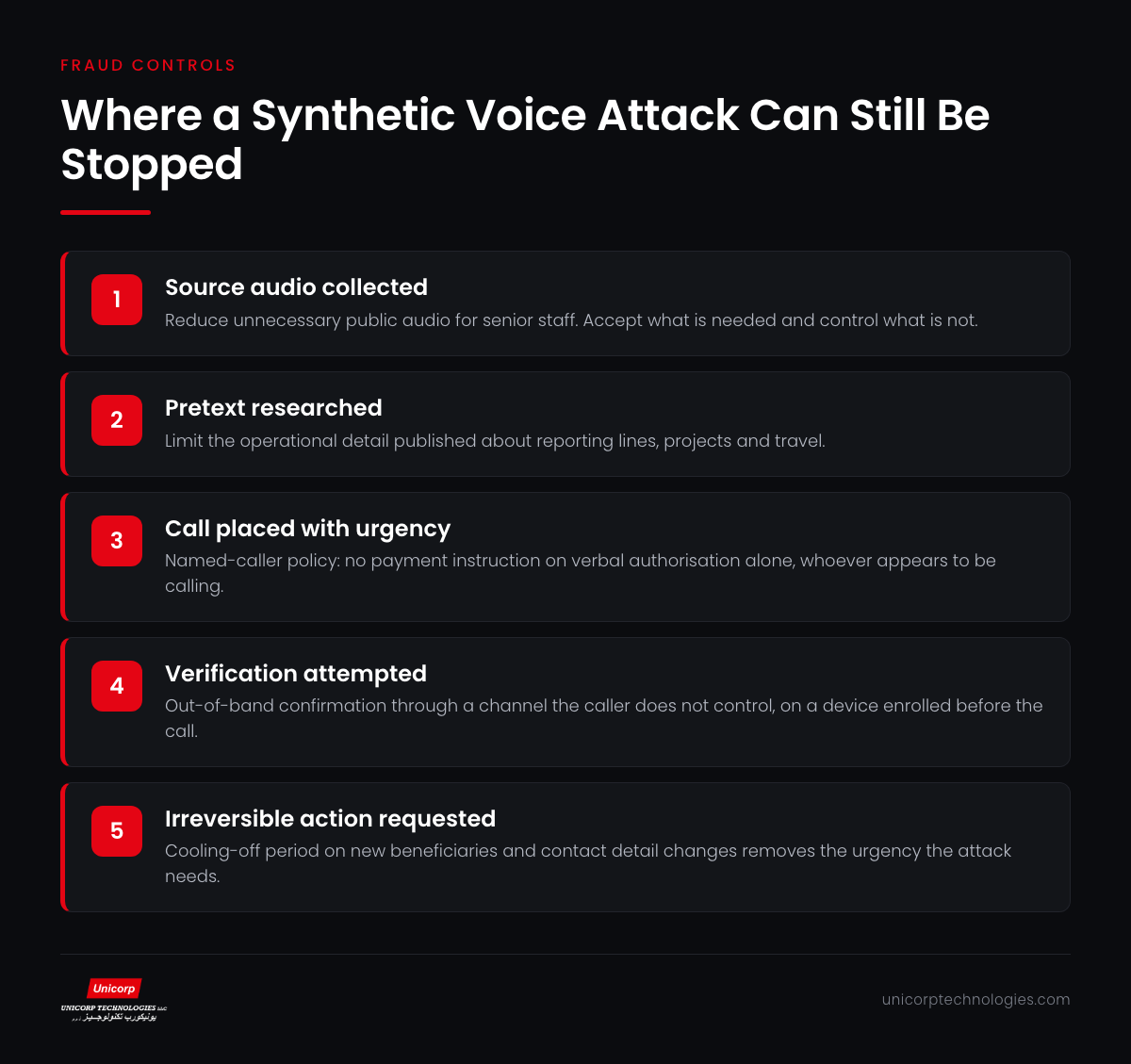
The operational sequence is consistent and unglamorous. Collect audio of the target, which for a senior executive means conference recordings, media interviews, webinars and social video, and for a retail customer often means a short recorded call obtained through a pretext. Modern voice cloning needs far less source material than most risk assessments assume.
Build the pretext next. Attackers research reporting lines, current projects, travel schedules and vocabulary, largely from public sources, so that the call contains details a stranger should not know. This context is what makes the voice credible; the audio alone rarely is.
Then create urgency and isolation. The call arrives near a deadline or outside normal hours, states that the matter is confidential, and gives a reason why the usual approval path cannot be used. Every effective version of this attack works by removing the target's opportunity to verify through a second channel.
Finally, direct the outcome to something irreversible. A payment to a new beneficiary, a change of registered contact details, a password reset, or the release of a document. The specific ask varies; the property that matters is that reversing it later is difficult or impossible.
Two variants dominate in the region. Executive impersonation targets finance staff, using a cloned senior voice to authorise an urgent transfer. Customer impersonation targets the contact centre, using a cloned customer voice to pass verification and change account details. They require different defences and should be treated as separate risks.
Why Existing Verification Fails
The verification stack most cyber security firms inherit when they review a contact centre starts with knowledge-based questions about recent transactions, addresses and identifiers, and assumes those answers are private. Breach data, data broker records and social engineering have made most of these answers obtainable, and an attacker who has done the research passes the questions comfortably.
Voice biometrics were introduced specifically to strengthen this, and they are now the control most directly undermined. Text-independent systems compare acoustic characteristics against an enrolled profile, and modern synthesis reproduces those characteristics well enough to score as a match in a meaningful proportion of attempts. Where a bank treats a biometric pass as sufficient, the control has become a liability rather than a defence.
Callback verification is stronger but frequently implemented in a way that removes its value. Calling back a number supplied during the same conversation, or a number recently changed in the record, verifies nothing. Only a callback to a number held in the system before the interaction began provides independent confirmation.
Dual authorisation fails when both authorisers can be reached through the same channel. If the caller impersonating an executive can also reach the second approver by phone with the same story, two approvals are one control. Independence has to be structural, not procedural.
Controls That Still Hold
The controls that cyber security firms consistently find still working share a single property: they verify through a channel the caller does not control, and they verify the transaction rather than the person. Out-of-band confirmation through the customer's registered banking application, sent to a device enrolled before the call, is the clearest example. The attacker holding the phone line cannot approve it.
Cooling-off periods on high-risk changes are unglamorous and highly effective. A twenty-four hour delay on new beneficiary payments above a threshold, or on changes to registered contact details, removes the urgency the attack depends on and gives the genuine customer a window to notice a notification they did not expect.
Named-caller policies protect the executive impersonation case. A standing rule that no payment instruction is executed on a verbal authorisation alone, regardless of who appears to be calling and how urgent the matter sounds, is simple to write and simple to audit. Staff need explicit permission to apply it to the most senior person in the organisation, which is the part that usually needs board endorsement.
Structured technique catalogues such as the MITRE ATLAS knowledge base for adversarial machine learning are a useful reference when mapping which of these attacks your controls actually address. Behavioural and contextual signals should feed the decision alongside any acoustic checks. Whether the calling number matches history, whether the device fingerprint is known, whether the request pattern fits the customer's history, and whether contact details changed recently. These signals are far more durable than deepfake detection, which degrades as generation improves.
National guidance on incident handling, such as the NCSC incident management collection, is worth aligning the response path to before an incident rather than during one. Detection tooling has a place as a supporting signal rather than a gate. Treat a synthetic-audio flag as a reason to escalate to a stronger verification path, never as the verification itself.
Training Staff for a Call That Sounds Real
Conventional fraud awareness training, of the kind most cyber security firms delivered five years ago, teaches staff to notice that something sounds wrong. That instruction no longer works, because the call sounds right, and telling people to trust their instincts against a convincing synthetic voice sets them up to fail and then blames them for it.
Replace recognition with procedure. Train staff that certain requests always trigger a defined verification path regardless of who is asking or how the request sounds. The trigger should be the nature of the request, not the perceived legitimacy of the caller, because the caller's legitimacy is exactly what the attack manufactures.
Make the escalation path socially safe. Most successful executive impersonation succeeds because a junior member of staff does not feel able to refuse a senior instruction. Written authority to apply the procedure to anyone, communicated by the chief executive personally, removes that barrier more effectively than any amount of awareness content.
Exercise it realistically. Simulated calls, run with proper consent and governance, reveal where the procedure breaks under time pressure in a way that a training module cannot. Rehearse the contact centre scenario and the finance scenario separately because the failure modes differ.
Track outcomes rather than completion. The useful measure is how often a request that should have triggered verification actually did, which requires logging the trigger rather than counting training attendance.
What UAE Institutions Should Change This Quarter
Start with an inventory of every process in which a phone call alone can authorise something irreversible. Payment release, beneficiary creation, contact detail changes, credential resets, card issuance and limit increases are the usual list. Most institutions find at least two processes nobody realised were exposed this way.
For each, decide whether the control should be out-of-band confirmation, a cooling-off period or a hard prohibition on verbal authorisation. Write the decision down and set a date. This exercise takes a working week and delivers more risk reduction than any procurement.
Second, review how voice biometrics are used. If a biometric pass currently satisfies verification on its own, change it to a contributing signal within a wider decision. This is a configuration and policy change rather than a project, and it closes the most directly exploited control.
Third, brief the board and the executive team specifically on the impersonation risk to themselves. Executives are the source material for the attack, and reducing their public audio footprint where it is not needed, while accepting it where it is, is a decision only they can take. Working with experienced cyber security firms on this briefing usually helps, because the conversation lands better with external evidence.
Finally, extend the same thinking to your channels beyond voice. Video conferencing, messaging and email all now carry synthetic-content risk, and the underlying principle does not change: verify the transaction through an independent channel rather than verifying the person through the channel they chose. Our note on cloud security services for hybrid enterprise operations covers the platform controls that support this, and our fraud and AI security team can run the process inventory with you. You can also see how SkyAlchemX applies AI within a governed perimeter and our work on secure AI systems in regulated sectors.
Where Accountability Sits
This risk falls between functions, which is why it persists. Fraud teams own the customer-facing processes, security teams own the technology, and the finance function owns payment authorisation. Synthetic voice attacks cross all three, and in most institutions no single role is accountable for the end-to-end path.
Naming that owner is the highest-leverage governance change available. The role does not need to be new; it needs authority over the process inventory described above and a reporting line to the committee that reviews fraud losses.
Reporting should cover attempted as well as successful incidents. Attempts are the leading indicator, and institutions that only report losses discover the trend after it has already cost them. Contact centre staff need a simple, low-friction way to log a suspicious call that took no further action.
External support is worth using selectively. Many cyber security firms and independent specialists can run a process review of this kind in a few weeks, and the value is usually in the questions asked of business process owners rather than in any technology recommendation that follows.
The underlying point is that this is a process problem wearing a technology costume. The technology made the attack cheap; the process decides whether it works.
Frequently Asked Questions
How much audio does voice cloning actually need?

Are voice biometrics now useless?
What is the single most effective control?
Why do cooling-off periods work so well?
How is executive impersonation different from customer impersonation?
Does deepfake detection software solve this?
What should we tell staff to look for?
How do we make refusing a senior executive safe?
Who should own this risk?