Third-Party AI Vendor Risk: A Procurement Checklist for UAE Enterprises

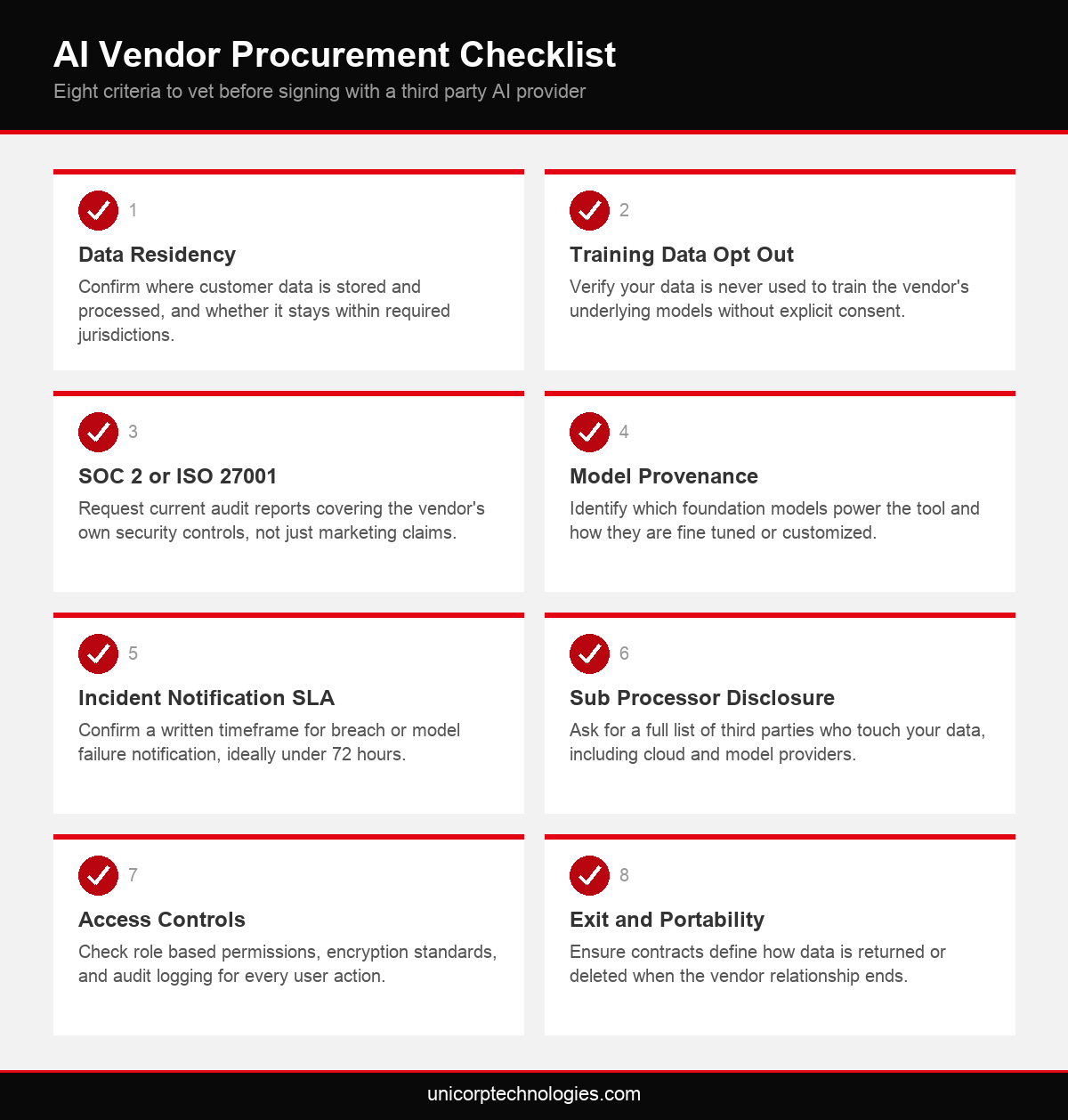
UAE enterprises now buy AI capability faster than they vet it. Procurement teams evaluating ai saas companies face a new category of vendor risk that traditional software checklists were never built to catch. This procurement checklist walks IT and procurement leaders through the questions that matter before signing with a third party AI vendor, covering data residency, training data use, independent certifications, model provenance, incident notification, and sub processor disclosure. Use it to structure vendor due diligence and avoid discovering AI specific gaps after a contract is already signed.
Key Takeaways
- Vetting ai saas companies requires questions beyond standard software procurement, including how vendors use your data to train models.
- Independent certifications such as SOC 2 or ISO 27001 for the AI vendor itself, not just its parent company, are non negotiable evidence.
- Contracts should specify incident notification timelines and sub processor disclosure before any data reaches the vendor.
Why Third-Party AI Vendors Carry Different Risk
A standard software vendor risk assessment does not ask the right questions for an artificial intelligence software provider relationship, where the product itself learns from the data you send it, and the underlying model may sit several layers removed from the vendor you signed a contract with.
Traditional SaaS procurement focuses on uptime, support, and standard data protection clauses. AI SaaS introduces additional variables. Model behavior can drift, training data may include content submitted by your own users, and the vendor may rely on a third party foundation model provider you never interact with directly. Enterprise cybersecurity companies increasingly treat AI vendor risk as a distinct due diligence category, separate from general software risk. UAE procurement teams evaluating ai saas companies should run a specialized review, not an add on to an existing vendor questionnaire, particularly where the tool touches customer data, financial records, or health information.
The stakes are higher because AI cybersecurity failures at a vendor rarely stay contained to that vendor. A misconfigured training pipeline or an undisclosed sub processor can expose your organization's data even when your own systems remain untouched. Procurement teams that treat every AI vendor as a standard SaaS line item inherit risk they never actually evaluated, often discovering the gap only during a compliance audit or after a public incident involving the provider.
Data Residency and Whether Your Data Trains the Model
Two questions belong at the top of any AI vendor questionnaire: where is data stored and processed, and does the vendor use customer data to train or fine tune its models without an explicit opt out. Both directly affect regulatory exposure for UAE organizations bound by data localization expectations.
Ask the vendor to confirm, in writing, the specific jurisdictions where data is stored and processed, not only where the company is headquartered. Many AI SaaS platforms route requests through cloud regions outside the UAE by default, which can create compliance friction for banking, healthcare, or government clients bound by data residency rules. Separately, confirm whether customer inputs are used to train or improve the vendor's underlying models. Reputable ai saas companies offer an explicit opt out or a contractual guarantee that customer data never enters a shared training pipeline. If a vendor cannot answer either question clearly, treat that as a disqualifying gap rather than a minor process question. Enterprise cybersecurity companies advising on procurement generally recommend requesting this in writing before a proof of concept begins, not after commercial terms are already agreed.
Certifications and Model Provenance to Verify
Ask for current audit evidence, not marketing claims. SOC 2 or ISO 27001 certification covering the AI vendor's own infrastructure, along with clarity on which foundation models power the tool and how they are fine tuned, gives procurement teams a factual basis for approval decisions.
Request the vendor's current SOC 2 Type II report or ISO 27001 certificate, scoped specifically to the AI product in question, not a parent company certification that predates the AI feature. Ask which foundation models power the platform, whether they are proprietary or licensed from a third party, and how the vendor fine tunes or customizes them for enterprise use. Frameworks referenced in the NIST AI Risk Management Framework and assurance programs like CSA STAR for AI give procurement teams a structured way to compare vendor claims. An artificial intelligence software provider that cannot describe its own model supply chain in plain terms has not done the due diligence it is asking your organization to skip.
It helps to separate certification scope from marketing language early in the conversation. Some AI vendors hold a valid SOC 2 report for their general cloud infrastructure but have never had the AI specific components independently assessed. Ask directly whether the audit covered the model pipeline, the training data handling process, and the access controls around customer prompts, not only the surrounding cloud environment.
Incident Notification and Sub-Processor Disclosure
Contracts should specify a written incident notification timeframe, ideally under 72 hours, covering both security breaches and AI specific failures such as model malfunction or data leakage. Vendors should also disclose every sub processor, including cloud and model providers, that touches customer data.
Standard breach notification clauses often do not account for AI specific incidents, such as a model unexpectedly generating or exposing sensitive content. Procurement teams should negotiate explicit notification triggers covering both categories, with a defined timeframe and a named contact. Vague language such as reasonable efforts or industry standard timelines should be replaced with a specific number of hours before a contract moves forward. Separately, request a full sub processor list. Many AI SaaS tools depend on cloud infrastructure providers and third party foundation model APIs that sit outside the primary vendor's direct control. A gen ai company dubai enterprises choose as an implementation partner should be able to name every party that touches customer data, and update that list whenever the sub processor chain changes. This level of transparency is a reasonable baseline expectation, not a special request, when evaluating enterprise cybersecurity companies or AI vendors handling regulated data.
Building a Repeatable Vendor Vetting Process
A one time checklist is not enough. Enterprises should build vendor vetting for ai saas companies into a repeatable procurement workflow, with the checklist above applied consistently, findings logged, and a defined owner responsible for renewal reviews as vendor terms change.
Assign a named owner, typically within IT security or procurement, responsible for running this checklist against every new AI vendor and revisiting existing vendor relationships on a fixed schedule, such as annually or at contract renewal. Store completed assessments centrally so audit teams can retrieve evidence quickly during compliance reviews. Our companion guide on how UAE organizations can audit AI systems for risk and compliance walks through building that internal review cadence. Treat any vendor that resists these questions as a signal, not an inconvenience, since enterprises that formalize this process report fewer surprises during security audits.
This same discipline strengthens the broader ai cybersecurity posture of the organization, since vendor risk rarely stays isolated from internal systems once integrations, APIs, and shared credentials come into play. Procurement, IT security, and legal should review this checklist together rather than in separate silos, since each function catches different gaps in a vendor's answers.
Smaller enterprises without a dedicated AI governance function can still apply this process. Start with the highest risk category, typically the vendor handling the most sensitive data, and work through the checklist before renewal rather than waiting for a formal governance program to exist. A partial review completed consistently beats a comprehensive review that never gets scheduled.
Vetting ai saas companies properly protects UAE enterprises long before a contract signature creates exposure. Data residency, training data opt out, current certifications, model provenance, and sub processor disclosure form the core of any defensible vendor review. Build these questions into procurement from the outset rather than retrofitting them after an incident.
Contact Unicorp Technologies to build a vendor risk procurement checklist tailored to your enterprise.