Building an Enterprise AI Acceptable Use Policy: A Template for UAE Organizations

Most enterprise AI policies fail in the same way. They are written as prohibitions, published once, and then quietly ignored by staff who have found that the tools genuinely help them work. Within six months the organisation has a policy that says one thing and a workforce doing another, which is worse than having no policy at all because it creates a false record. Workable ai governance for employee usage starts from the opposite premise: that people will use these tools, that most of that use is legitimate, and that the policy's job is to make the safe path the easy one. This article provides a section-by-section template UAE organisations can adapt, with the reasoning behind each clause. Our note on applying AI governance without slowing innovation covers the broader programme.
Key Takeaways
- A policy that only prohibits produces shadow usage on personal accounts, which is the outcome it was written to prevent. Provide a sanctioned tool before publishing restrictions.
- Classify by data rather than by tool. The question staff need answered is what they may put into a system, not which brand names appear on an approved list.
- Publish the policy with a monitoring capability behind it. A rule nobody can verify is guidance, and it will be treated accordingly.
Why Prohibition-Only Policies Fail
The pattern is consistent across sectors. An organisation becomes aware of generative AI, issues a policy prohibiting its use with company data, and considers the matter closed. Staff who were already getting value from these tools continue using them on personal accounts and personal devices, where there is no logging, no data residency guarantee and no way to know what has been shared.
The prohibition therefore does not reduce usage; it relocates it beyond visibility. Every subsequent incident is harder to investigate because the activity happened outside the estate, and the organisation's own policy prevents staff from reporting it honestly.
The second failure mode is a policy written at a level of abstraction nobody can apply. Statements such as employees must exercise appropriate caution when using artificial intelligence tools give an individual under time pressure no way to decide whether the specific thing they are about to do is permitted.
Effective ai governance for employee usage therefore has two prerequisites before a word is written. A sanctioned tool that is genuinely useful, so that the compliant path is also the convenient one. And a monitoring capability, so that the policy can be verified rather than merely asserted. Our note on why enterprises need full visibility into workforce AI usage covers that second requirement.
Recognised governance frameworks such as the NIST AI Risk Management Framework give the policy a defensible structure and a vocabulary that auditors already accept.
Section One: Scope and Definitions
Open by naming what the policy covers, in language staff recognise. Generative assistants, coding tools with AI features, meeting transcription and summarisation, AI features embedded in software the organisation already licenses, and AI agents that act with their own credentials. The last category is frequently omitted and is the one with the highest risk.
State clearly that the policy applies regardless of device or account. Using a personal account on a personal laptop to process company information is in scope, and saying so explicitly removes the most common argument raised after an incident.
Define the terms you will use later, particularly the difference between using an AI tool to help draft something and giving an AI system the ability to act on your behalf. Staff understand the first intuitively and frequently do not recognise when they have crossed into the second.
Name the jurisdictions the policy has to satisfy. UAE entities frequently operate across free zone and mainland regimes with different data handling expectations, and staff working for a group with entities outside the country need to know which rules apply to the data in front of them rather than to the office they sit in.
Keep this section short. Two pages of definitions guarantees that nobody reads the sections that matter, and the definitions that matter number about six.
Name the policy owner and the review date on the first page. AI capability changes fast enough that an annual review is the minimum, and a policy with no visible review date is assumed to be stale whether or not it is.
Section Two: Data Classification Rules
This is the section staff will actually use, and it should be written accordingly. Organise it by data class rather than by tool, and state plainly for each class which categories of AI system may receive it.
A workable structure has four rows. Public information may be used with any sanctioned tool. Internal information may be used with tools where the organisation holds a contract preventing training on its data. Confidential information may only be used with approved enterprise tools inside the tenant. Restricted information, such as customer financial records, health data or credentials, may not be submitted to any AI system.
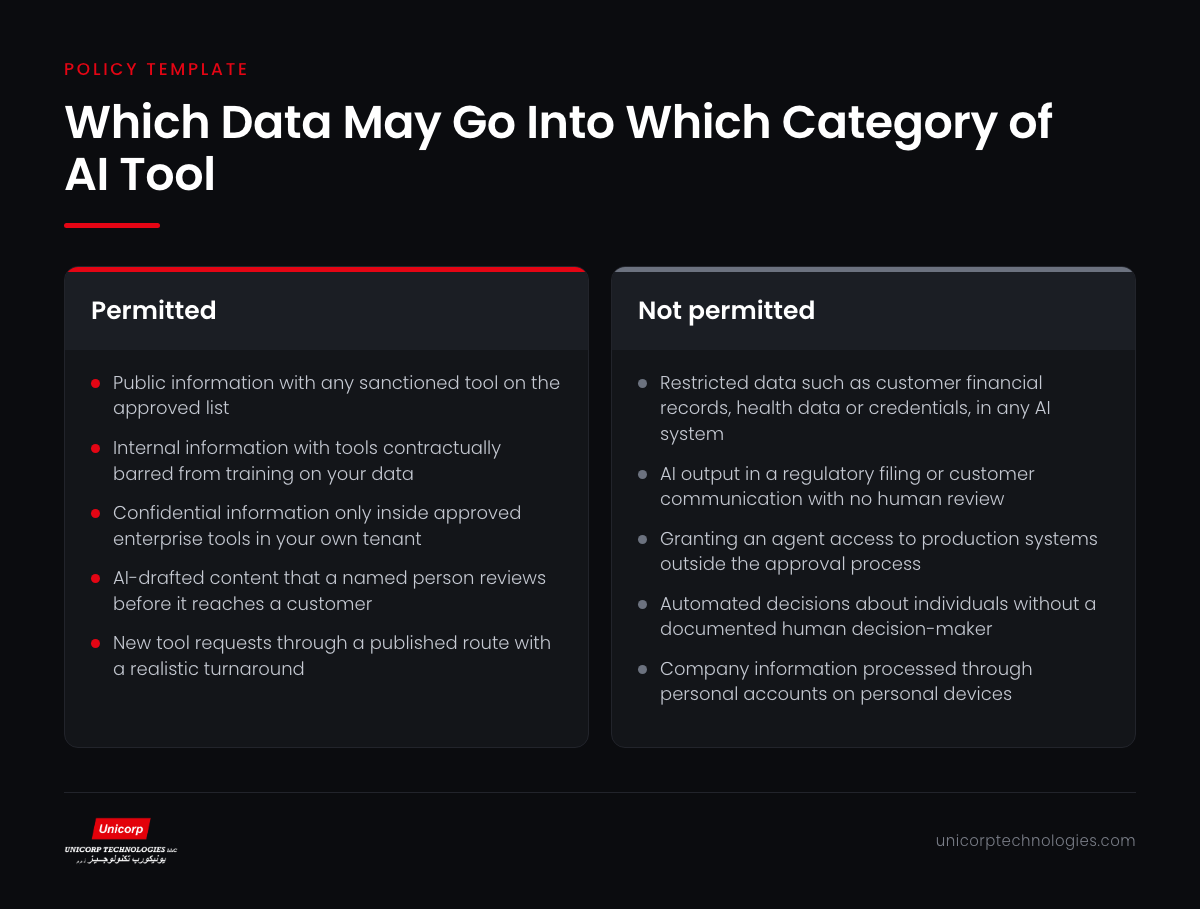
Give concrete examples for each row using content types your staff actually handle. Abstract classification labels are interpreted inconsistently under time pressure, and three worked examples per row does more for compliance than a page of definitions.
Say what happens when someone is unsure. A named contact, a shared mailbox or a channel where a question can be asked in under a minute is worth more than any amount of written guidance, because the alternative is that the individual guesses and does not tell anyone. Make it explicit that asking is always acceptable and never counted against the person asking.
Address output as well as input. AI-generated content used in customer communications, regulatory filings or code that reaches production needs a human review step, and the policy should name who is accountable for that review rather than leaving it implied.
Section Three: Approved Tools and How to Add One
List the sanctioned tools with what each may be used for, and keep the list current. A stale approved list is the fastest route to shadow usage, because staff conclude the process is not maintained and stop consulting it.
More important than the list is the route to add something to it. Publish the request process, the evaluation criteria and a realistic turnaround time. Where the process takes three months, teams will not use it, and the policy will be enforced against people who tried to comply.
State the evaluation criteria openly: contractual terms on training and data retention, data residency, authentication and access controls, logging available to the customer, and the vendor's own security posture. Making these visible lets teams pre-screen tools before requesting them, which reduces the volume of requests substantially.
Include a fast path for low-risk cases. A tool that will only ever process public information does not need the same evaluation as one handling confidential records, and a tiered process keeps the queue moving.
Handle embedded AI explicitly. Features appearing inside software the organisation already licenses often arrive without a procurement decision, and the policy should state who assesses them and what happens by default until they are assessed.
Section Four: Prohibited Uses and Consequences
Where the organisation processes personal data, align this section with the security requirements you already meet elsewhere. The OWASP Top 10 for large language model applications is a useful reference for the technical risks that sit behind several of these clauses, particularly for teams building rather than merely using AI features.
Keep prohibitions short, specific and defensible. Submitting restricted data to any AI system. Using AI output in a regulatory filing or customer communication without human review. Granting an AI agent access to production systems without going through the approval process. Using AI to make employment, credit or similar decisions about individuals without a documented human decision-maker.
Each prohibition should be one a reasonable employee understands immediately and a manager can enforce consistently. Long prohibition lists dilute the ones that matter, and prohibitions that cannot be detected teach staff that the policy is decorative.
State consequences proportionately and honestly. Where the organisation genuinely will not discipline someone for a first accidental disclosure, say so, because an overstated consequence discourages the reporting that limits damage. What matters far more than severity is that staff know incidents must be reported and how.
Include a no-blame reporting route with a named contact. The most valuable thing a policy can produce is a phone call from someone who has just pasted something they should not have, within minutes rather than months.
Our note on stopping corporate data leaks through enterprise AI monitoring covers the detection side that makes this section enforceable.
Rolling It Out and Keeping It Alive
Publish the sanctioned tool first and the policy second, with a short gap between them. Staff who already have a working alternative accept restrictions far more readily than staff who are told to stop and offered nothing.
Communicate through the classification table rather than the full document. A single page showing what may go into which tool, with real examples, is what people will keep. The full policy exists for the audit file and for the small number of cases where detail matters.
Train by role rather than uniformly. Developers, customer-facing staff, finance teams and HR each face different decisions, and a generic module addresses none of them well. Fifteen minutes of role-specific guidance outperforms an hour of general content.
Review quarterly for the first year. New capabilities appear faster than annual cycles accommodate, and a policy that has not changed in a year in this area is almost certainly out of date. Publish what changed at each review so staff know the document is live.
Monitor and report usage against the policy, because ai governance for employee usage that cannot be measured will drift. If you want help drafting or reviewing your policy against this structure, our AI governance team can work through it with you. You can also see how SkyAlchemX applies AI within a governed perimeter.
Frequently Asked Questions
Why do prohibition-only AI policies fail?

What must be in place before publishing the policy?
Should the policy be organised by tool or by data?
What classification structure works best?
Does the policy cover personal devices and accounts?
How should new tools be approved?
What should the prohibited list contain?
How should consequences be stated?
How often should the policy be reviewed?