Managed Security vs In-House Security: A Strategic Comparison

The build-or-buy question in security is usually framed as a cost comparison, which is why so many organisations answer it badly. A twenty-four hour internal capability is not one salary against one invoice; it is a minimum of five analysts, a tooling stack, a threat intelligence subscription and a recruitment pipeline that has to keep working every year. Weighed honestly, managed security services and internal teams turn out to be strong at different things, and the right answer for most UAE enterprises is a deliberate split rather than a choice. This article sets out how to compare the two on true cost, coverage, control and context, and how to design the split so neither side ends up owning something it cannot do well. Our note on proven security outcomes and AI guidance in the UAE provides the wider background.
Key Takeaways
- Continuous internal coverage requires a minimum team of around five analysts before any tooling, which is the number that decides the economics for most mid-sized enterprises.
- Providers win on coverage, tooling economics and cross-client visibility. Internal teams win on business context, decision authority and institutional memory.
- The hybrid split works when the boundary is drawn by decision rights rather than by tools, with the provider detecting and the enterprise deciding.
Counting the True Cost of Building
The arithmetic that decides this question is coverage. Providing continuous monitoring across a week requires roughly five full-time analysts once shift patterns, leave, training and attrition are accounted for. Anything less produces a team that covers business hours and calls someone at home outside them, which is a different service and should be compared as one.
On top of headcount sits the tooling stack. Log collection and retention, detection tooling, endpoint telemetry, threat intelligence and case management each carry licence and infrastructure costs, and the licensing models are usually volume-based, meaning cost grows with the estate rather than with the team. Providers spread these costs across clients; an internal team carries them alone.
Then there is the pipeline cost that rarely appears in a business case. Security analysts in the UAE market are scarce and mobile, and a team of five will lose one to two people a year. Each departure costs recruitment fees, several months of reduced capacity and the knowledge that left with them. Budgeting for a stable five is budgeting for a team that will not exist by the second year.
None of this argues against building. It argues for comparing complete scopes. An internal team providing business-hours coverage with on-call escalation is a legitimate model that many enterprises run successfully, and it should be compared against a provider scope that matches it rather than against a full round-the-clock service.
Recognised control frameworks help here by making the scope explicit. Mapping both options against the NIST Cybersecurity Framework functions shows which parts of detect, respond and recover each option actually covers, which turns a price comparison into a capability comparison.
What Providers Genuinely Do Better
Coverage is the advantage managed security services are bought for, and it is decisive for many organisations. A provider running an established operations centre covers nights, weekends and public holidays without your organisation carrying the staffing risk, and the analysts on shift at three in the morning are working rather than being woken.
Cross-client visibility is the less obvious advantage and often the more valuable. A provider watching many estates across a region sees a technique used against one client and can hunt for it across the others the same week. No single enterprise, however well staffed, has that view of its own estate alone.
Tooling economics follow the same logic. A provider amortises detection tooling, intelligence feeds and specialist expertise across a client base, which puts capabilities within reach that would be difficult to justify for one enterprise. Detection engineering capacity in particular is hard to sustain internally at mid-market scale.
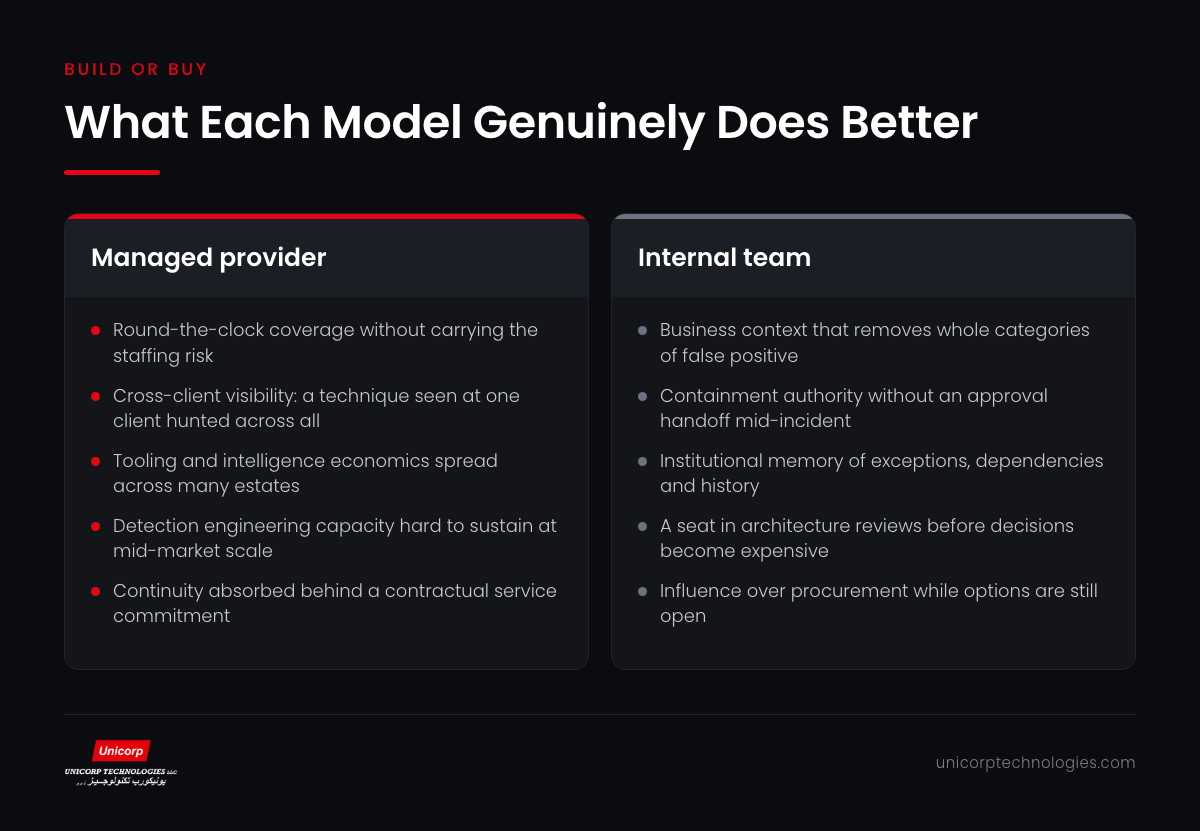
Continuity is the final one. An internal team's capability walks out of the door with each resignation. A provider absorbs that turnover behind a contractual service commitment, which is precisely what enterprises are paying the margin for.
What Internal Teams Do Better
Business context is the internal team's decisive advantage over any managed security services arrangement. Knowing that a bulk export from a finance system is normal in the first week of the quarter and alarming in the third, or that a particular supplier account legitimately touches production monthly, removes a category of false positives that no external analyst can resolve without asking.
Decision authority is the second. An internal analyst can isolate a machine, disable an account or block a supplier connection because they hold the authority to do so. A provider almost always has to seek approval, and the minutes lost in that handoff are the minutes that matter during containment.
Institutional memory is the third. Knowing why an exception was granted in 2023, which system the payroll integration depends on, and who to call when the manufacturing line is affected is knowledge that accumulates internally and is difficult to transfer into a service relationship.
Cultural influence is the fourth and least measured. A security team that sits in the building gets invited to architecture reviews, hears about projects before they are procured, and can influence decisions at the point they are cheap to change. External providers reviewing documentation after the fact cannot replicate this.
Enterprises that outsource everything typically discover the gap within a year, usually when an incident requires a decision that only someone with business context and authority can take. That is the failure mode the hybrid model exists to prevent.
Designing the Hybrid Split
A hybrid arrangement between managed security services and an internal team works when the boundary is drawn by decision rights rather than by tools. The provider owns detection: monitoring, triage, enrichment and escalation with a recommended action. The enterprise owns the decision: containment authority, business impact judgement and communication. Splitting by tool ownership instead produces disputes about who was watching which console.
That split implies a minimum internal capability, which is smaller than a full team but not zero. A security manager who owns the relationship and the risk decisions, an engineer who owns identity and endpoint configuration, and a named incident decision-maker available out of hours. Three roles, not fifteen.
Pre-authorisation is what makes the model fast. Agree in advance which containment actions the provider may take without waiting: isolating a workstation, disabling a compromised account, blocking a known malicious address. Each pre-authorised action removes a round trip from the response, and the list should be reviewed after every significant incident.
Onboarding determines whether the arrangement works. The provider needs the asset inventory, the business criticality of each system, named contacts per application, and the exceptions that are legitimate in your environment. Enterprises that treat onboarding as a technical connection exercise spend the first six months buried in false positives.
Our note on why UAE security companies prioritise employee training in risk management covers the internal capability side that no provider can supply for you.
Evaluating Providers on the Right Criteria
Ask what the provider actually monitors rather than what they can monitor. Many managed security services quote a broad capability and deliver against the log sources you happen to send them. The contract should name the sources, the coverage each provides, and what happens when one stops reporting.
Ask for detection engineering evidence. How often are new detections written, how are they tested, and how does a technique observed at another client become a detection on your estate. A provider running a static rule set is selling monitoring rather than detection, and the difference shows during a novel attack.
Structured incident handling guidance such as NIST SP 800-61 is a fair yardstick for the response process a provider proposes. Ask about escalation quality, not escalation speed. A fast alert with no enrichment moves work to you; a slower alert with context, affected assets and a recommended action removes it. Request sample escalations from a real incident, redacted, and judge them the way you would judge a report from any supplier.
Ask what happens at exit. Whether your log data is portable, whether detections written for your estate transfer to you, and how long the transition support lasts. Enterprises comparing it managed service providers rarely ask this until they want to leave, at which point the answer is expensive.
Finally, confirm data residency and access. Where logs are stored, which jurisdictions analysts operate from, and who inside the provider can read your data. For UAE regulated entities these questions are frequently decisive and are much easier to settle before contract than after.
Making the Decision
Start by writing down what coverage you actually need, which is a business decision rather than a security one. An organisation whose services are used only in business hours may reasonably accept business-hours monitoring with on-call escalation. A payments processor cannot. That single answer removes most of the options.
Then count the internal capability you already hold, honestly. Not headcount in the security team, but people who can write a detection, run an investigation and take a containment decision. Most mid-sized enterprises find this number is one or two, which settles the question of whether a full internal build is realistic in the near term.
Compare like-for-like scopes. If you are pricing managed security services against an internal build, ensure both include tooling, intelligence, retention and the coverage hours you defined in step one. Business cases that compare a full service against partial internal coverage produce decisions that unravel at the first out-of-hours incident.
Plan for the arrangement to change. Enterprises that build internal capability over time often start with a broad service and narrow it as their own team grows, and the contract should permit that without penalty. Equally, an internal team that loses two analysts may need to widen the service quickly, which is easier when the relationship already exists.
If you want a structured comparison against your own estate and coverage requirement, our team can run the exercise with you. You can also see how our professional services practice structures hybrid arrangements, and our note on consolidated secure access for UAE enterprises.