Modern Identity Threats: Why Identity and Access Management Can't Rely on MFA Alone
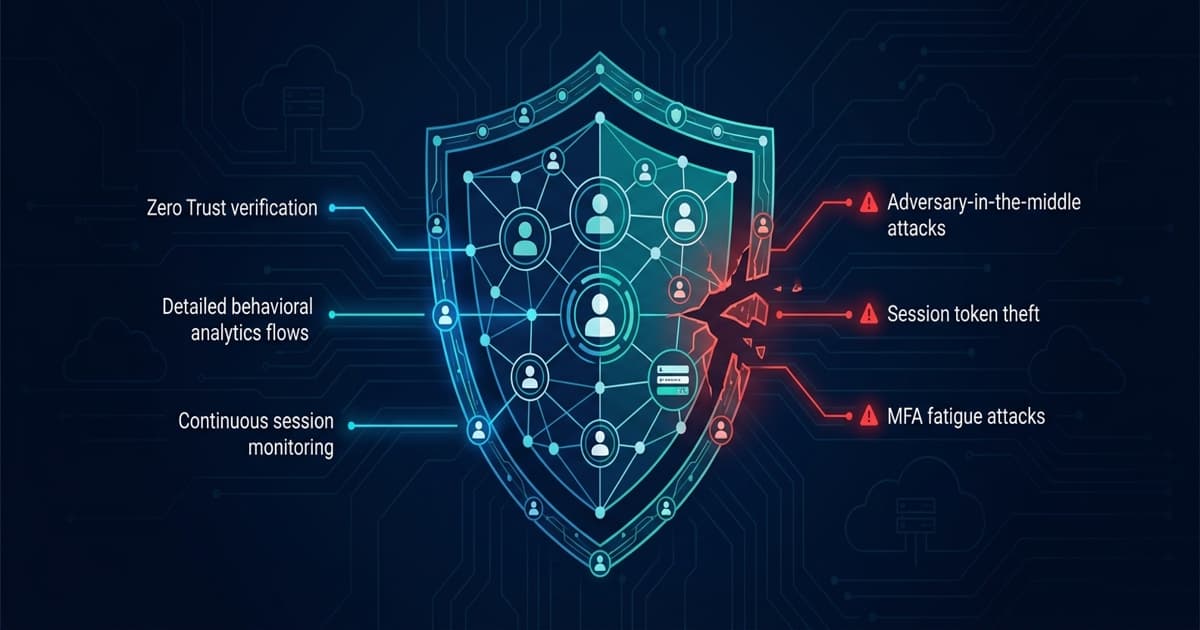
Identity and access management has long been treated as a solved problem. Deploy MFA, enforce strong passwords, and access is secured. That assumption is now dangerously outdated. Today's attackers do not need to steal passwords. They hijack authenticated sessions, steal browser tokens, exploit cloud credentials, and bypass authentication workflows entirely. As identity becomes the primary enterprise attack surface, relying on MFA alone creates a false sense of security that sophisticated threat actors are actively exploiting.
Key Takeaways
Identity and access management must evolve beyond MFA to include continuous risk evaluation, behavioral analytics, and identity threat detection throughout every session.
Modern attackers use MFA fatigue, adversary-in-the-middle phishing, session token theft, and OAuth consent abuse to bypass even enforced authentication controls.
A resilient identity security strategy combines IAM, PAM, PIM, and ITDR with Zero Trust remote access principles to treat every access request as potentially compromised.
Organizations leveraging managed security services gain continuous identity monitoring and automated response capabilities that internal teams often cannot maintain alone.
How the Identity Threat Landscape Has Changed
The environment in which identity security must operate has transformed fundamentally. Enterprises no longer protect a defined perimeter. They manage thousands of identities across cloud platforms, SaaS applications, remote endpoints, and automated pipelines. This complexity introduces new attack surfaces that traditional authentication cannot address.
Cloud-First Enterprises and Identity Risk
Cloud adoption has moved identity to the center of security architecture. In traditional on-premises environments, network boundaries provided implicit trust. In cloud-first environments, every resource access decision depends entirely on identity verification. Attackers who compromise cloud credentials gain access to storage, compute resources, and entire application environments. Cloud security services now treat identity as the primary control plane, but that control plane requires continuous protection rather than one-time authentication.
Remote and Hybrid Workforces
The shift to remote and hybrid work has dramatically expanded identity attack surfaces. Employees access enterprise resources from personal devices, home networks, and shared environments. Each access point introduces risk. Secure remote access solutions built solely on VPN and MFA no longer provide adequate protection when session tokens can be stolen from endpoints outside corporate security controls. Organizations need remote work security solutions that enforce identity verification continuously rather than at login alone.
Explosion of SaaS Applications
The average enterprise now uses hundreds of SaaS applications, each requiring separate identity management. Shadow IT introduces unauthorized applications with unmanaged credentials. OAuth integrations create chains of trust that attackers exploit through consent phishing. Managing identity consistently across this environment requires centralized visibility and governance that MFA cannot provide independently.
Machine and Non-Human Identities
Service accounts, API keys, automation scripts, and AI agents now outnumber human identities in most enterprise environments. These non-human identities rarely have MFA applied and are often over-privileged. Compromising a single service account or API key can grant attackers persistent access to critical systems without triggering authentication alerts.
Why MFA Alone Is No Longer Enough
According to CISA guidance on phishing-resistant MFA, traditional MFA methods including SMS one-time passwords and push notifications may not stop modern phishing campaigns. Attackers have developed systematic techniques specifically designed to circumvent MFA controls.
MFA Fatigue Attacks
MFA fatigue exploits the human element of push-based authentication. Attackers with stolen credentials repeatedly send MFA push notifications until the targeted user approves one out of frustration or confusion. This technique requires no technical bypass of the authentication system itself. It simply exploits the user's response to repeated interruption. High-profile breaches at major organizations have demonstrated that MFA fatigue remains a viable and effective attack vector in 2025.
Adversary-in-the-Middle (AiTM) Phishing
AiTM phishing kits such as Evilginx and Modlishka act as reverse proxies between the victim and the legitimate service. The attacker captures both the credentials and the authenticated session cookie in real time, bypassing MFA entirely because the authentication has actually completed legitimately. The attacker then replays the session token independently. NIST Digital Identity Guidelines SP 800-63 recommend phishing-resistant authenticators such as FIDO2 and hardware security keys as a direct countermeasure to this technique.
Session Token Hijacking
Once a user authenticates successfully, the resulting session token often persists for hours or days. Attackers who obtain this token through malware, man-in-the-browser attacks, or endpoint compromise gain full authenticated access without ever triggering MFA. The authentication event is legitimate. What follows is not. This is why continuous session monitoring has become a foundational requirement for modern identity and access management.
Browser Cookie Theft
Infostealer malware specifically targets browser cookie stores to extract authenticated session cookies. Once extracted, these cookies can be imported into attacker-controlled browsers, bypassing all authentication requirements including MFA. The Verizon Data Breach Investigations Report consistently identifies credential and session data abuse among the leading initial access vectors in enterprise security incidents.
OAuth Consent Phishing
OAuth consent phishing tricks users into granting malicious third-party applications access to their accounts. Because the victim authorizes the application directly through a legitimate OAuth flow, MFA does not prevent the compromise. The attacker receives a persistent access token granting long-term access to email, files, and connected services without needing credentials at all.
Common Identity Attack Techniques in 2026
Credential Theft
IBM's Cost of a Data Breach Report identifies compromised credentials as one of the costliest and most frequent causes of enterprise breaches. Credential theft encompasses phishing, brute force, password spraying, and infostealer malware. Even with MFA enforced, stolen credentials represent the first step in a chain of techniques that eventually achieves authenticated access.
Privilege Escalation
Attackers who gain initial access with low-privilege credentials frequently escalate to administrative accounts using misconfigured permissions, unpatched vulnerabilities, or stolen privileged credentials. Privilege escalation is a core technique in identity-based attacks because elevated access enables lateral movement, data exfiltration, and persistent backdoors. This is precisely why Privileged Access Management (PAM) and Privileged Identity Management (PIM) are critical complements to standard identity and access management controls.
Identity Impersonation
Attackers impersonate legitimate users by replaying stolen tokens, forging identity assertions, or abusing federated identity trust relationships. In cloud environments, identity impersonation through stolen service principal credentials can grant access to entire subscriptions and resource groups.
Insider Threats
Malicious or negligent insiders represent a distinct identity threat category because they authenticate legitimately. Detecting insider threats requires behavioral analytics and anomaly detection rather than authentication controls. Traditional MFA offers no protection against a legitimately authenticated insider acting maliciously.
Cloud Identity Abuse
Cloud environments expose identity attack surfaces that do not exist in on-premises architectures. Attackers target identity provider configurations, federated trust relationships, role assignments, and conditional access policy gaps. As organizations expand multi-cloud deployments, cloud identity abuse becomes an increasingly sophisticated and damaging threat vector.
What Modern Identity and Access Management Security Looks Like
Addressing the modern identity threat landscape requires moving beyond point-in-time authentication toward continuous, risk-based identity assurance. This is the foundation of effective cyber security systems built for the current threat environment.
Adaptive Authentication
Adaptive authentication evaluates contextual signals including device health, location, behavior patterns, and risk scores to determine the appropriate level of authentication required at any given moment. A user accessing sensitive data from an unmanaged device in an unusual location triggers additional verification. The same user accessing routine systems from a known device may receive a frictionless experience. This risk-based approach significantly reduces the attack surface compared to static MFA policies.
Conditional Access Policies
Conditional access policies enforce identity-based decisions across every access request. They evaluate user identity, device compliance, application sensitivity, network location, and real-time risk signals before granting or blocking access. Policies can require step-up authentication, restrict access to compliant devices, or block access entirely based on risk thresholds. Conditional access is a foundational component of zero trust remote access architectures.
Identity Threat Detection and Response (ITDR)
Gartner identifies Identity Threat Detection and Response (ITDR) as a critical capability for addressing sophisticated identity-based attacks that bypass traditional controls. ITDR continuously monitors identity infrastructure, detects anomalous behavior, correlates identity events across systems, and enables automated or guided response to identity-based threats. ITDR fills the gap between authentication controls and threat detection that MFA alone cannot address.
Behavioral Analytics
User and Entity Behavior Analytics (UEBA) establishes baseline behavioral profiles for every identity in the environment. Deviations from normal patterns such as unusual access times, atypical data volumes, or geographic anomalies trigger alerts and automated responses. Behavioral analytics detect compromised accounts even when the attacker possesses valid credentials and has passed all authentication controls.
Continuous Session Monitoring for Identity and Access Management
Modern identity and access management does not end at login. Continuous session monitoring evaluates every action within an authenticated session against expected behavioral baselines and policy rules. Anomalous activity mid-session triggers real-time responses including session termination, re-authentication requirements, or security alerts. This capability is essential for detecting session hijacking and insider threats that occur after successful authentication.
Passwordless Authentication
Passwordless authentication using FIDO2 standards, hardware security keys, and biometric verification eliminates the credential theft attack vector entirely. Without a password to steal, phishing campaigns targeting credentials become significantly less effective. NIST SP 800-63 and Microsoft both advocate for passwordless adoption as a long-term strategy for reducing identity attack surface.
How IAM, PAM, PIM, and ITDR Work Together
Effective identity security requires these technologies to function as an integrated system rather than isolated point solutions. Each addresses a distinct layer of the identity security challenge.
Technology | Primary Purpose | Strengths | Limitations |
|---|---|---|---|
IAM | Manage user identities and access rights across systems | Centralizes access control, enforces least privilege | Does not detect post-authentication threats |
MFA | Add verification factors to authentication events | Blocks credential-only attacks effectively | Bypassed by AiTM, token theft, fatigue attacks |
PAM | Control and audit privileged account access | Reduces privileged credential exposure | Scope limited to privileged accounts |
PIM | Enforce just-in-time and just-enough access for privileged roles | Minimizes standing privilege and lateral movement risk | Requires mature governance processes |
ITDR | Detect and respond to identity-based threats in real time | Identifies threats that bypass authentication controls | Requires quality identity telemetry and tuning |
When integrated, these technologies create a layered identity security architecture. IAM governs access rights. MFA provides authentication assurance. PAM and PIM control privileged access risk. ITDR detects and responds to threats that bypass all other controls. No single layer provides complete protection. The combination creates defense in depth for identity security.
Building a Resilient Identity Security Strategy
Implement Zero Trust Principles for Identity and Access Management
Zero Trust remote access treats every access request as potentially compromised regardless of network location or previous authentication status. Under Zero Trust, identity verification is a continuous process rather than a single event. Access is granted based on verified identity, device health, application sensitivity, and real-time risk context. Zero Trust security services help UAE organizations implement this architecture across hybrid and remote environments where traditional perimeter controls no longer apply.
Strengthen Identity Governance
Identity governance ensures that access rights are appropriate, regularly reviewed, and promptly revoked when no longer needed. Access creep, where users accumulate permissions over time, significantly expands the blast radius of any identity compromise. Regular access certifications, role-based access controls, and automated provisioning and deprovisioning are foundational governance practices that reduce identity risk.
Reduce Privileged Access
Privileged accounts represent the highest-value targets for identity attackers. Organizations should enforce just-in-time access, eliminate standing administrative privileges, and require explicit justification for privileged access requests. Reducing the number of permanently privileged accounts directly reduces the attack surface available to adversaries who have achieved initial access through compromised credentials.
Continuously Monitor Identity Risk
Identity risk monitoring requires collecting and correlating telemetry from identity providers, endpoints, cloud platforms, and applications. Security teams need visibility into authentication events, access patterns, privilege usage, and lateral movement indicators. Organizations leveraging managed security services can maintain this visibility continuously without requiring dedicated internal resources for around-the-clock monitoring. Read more about how managed security services are shaping cybersecurity in the UAE for enterprise identity protection strategies.
Automate Identity Response
When identity threats are detected, response speed is critical. Automated response capabilities can disable compromised accounts, revoke active sessions, enforce re-authentication, and alert security teams within seconds of detecting anomalous behavior. Manual response processes are too slow to contain modern identity-based attacks that move laterally within minutes of initial compromise.
Future Trends in Identity Security
The identity threat landscape will continue to evolve through 2026 and beyond. Security leaders should prepare for several emerging trends that will reshape identity and access management strategy.
AI-powered identity attacks are enabling attackers to generate highly personalized phishing content, automate credential stuffing at scale, and use machine learning to identify optimal attack timing based on behavioral patterns. AI cybersecurity and Zero Trust identity risk management must evolve together to address this threat.
Deepfake-enabled authentication fraud uses synthetic voice and video to defeat biometric authentication and social engineering defenses. As deepfake technology becomes more accessible, organizations relying on voice or facial recognition as authentication factors must add additional verification layers.
Identity-centric ransomware uses compromised privileged identities to deploy ransomware across entire environments in minutes. Attackers prioritize identity infrastructure because controlling an organization's identity provider effectively controls everything that identity provider governs.
Non-human identity management will become a critical discipline as AI agents, automation workflows, and microservices multiply the number of machine identities requiring governance. Organizations without visibility into non-human identity activity face significant blind spots in their enterprise security platform architecture.
Passwordless enterprise adoption and decentralized identity frameworks will gain adoption as organizations seek to eliminate credential-based attack vectors entirely. These represent the long-term direction of identity security beyond MFA and traditional authentication models.
Conclusion: Identity Security Is the Foundation of Enterprise Cyber Resilience
MFA remains an essential security control. But it is one layer in a defense-in-depth identity security strategy, not a complete solution. As attackers increasingly target authenticated sessions, cloud credentials, privileged identities, and authentication workflows, organizations must evolve their identity and access management approach to match the sophistication of modern threats. Continuous verification, behavioral analytics, identity threat detection, privileged access controls, and Zero Trust principles together create the layered identity security architecture that today's enterprise environments require.
Unicorp Technologies helps organizations across the UAE build identity security frameworks that go beyond authentication. Our team integrates IAM, ITDR, adaptive authentication, PAM, and continuous monitoring into cohesive cyber security systems designed for cloud-first and hybrid environments. Explore our approach to enterprise security platforms in the age of AI to understand how modern identity protection fits within your broader security architecture. Connect with our experts today to assess your current identity security posture and build a resilient strategy for the threats ahead.
Frequently Asked Questions
What is identity and access management and why does it matter?

Why is MFA no longer sufficient as a standalone security control?
What is an adversary-in-the-middle phishing attack?
What is Identity Threat Detection and Response (ITDR)?
How does Zero Trust improve identity and access management security?
What are the most common identity attack techniques used in 2026?
What are remote work security solutions for identity protection?
How do PAM and PIM complement identity and access management?
What role do managed security services play in identity protection?
What future identity threats should enterprises prepare for?