SASE for BFSI: Consolidating ZIA, ZPA & ZDX Into One Zero Trust Cloud
SASE security is no longer optional for banks and financial institutions running branches, trading desks and remote back offices across the UAE. Zscaler's Secure Access Service Edge model converges three distinct modules, Zscaler Internet Access (ZIA), Zscaler Private Access (ZPA) and Zscaler Digital Experience (ZDX), into a single Zero Trust cloud. BFSI teams already exploring zero trust security services know that Zero Trust is a strategy, not one control. This guide breaks down what each module does for BFSI operations and how Unicorp helps implement them.
Key Takeaways
SASE security is three separate modules, ZIA, ZPA and ZDX, not one product, and BFSI teams get the most value when procurement scopes all three from the start. ZPA replaces branch and back office VPNs with identity based access to specific banking applications, without exposing the private network to a compromised device. BFSI environments need ZDX because performance problems on a cloud delivered network stay invisible until a trading application slows down mid session, which is why SASE security procurement should include performance monitoring, not just access control.
SASE Security Means Three Modules, Not One Login Screen
Many BFSI IT teams treat SASE security as a single product purchase. In practice, Zscaler delivers three purpose built modules under one architecture. ZIA secures outbound traffic, ZPA secures inbound access to private applications, and ZDX monitors the experience layer connecting both. Treating SASE security as one bundle is where rollouts in banking lose momentum.
Banks and financial institutions in the UAE often start a SASE security project assuming it replaces a firewall with a single cloud service. That assumption causes confusion during procurement and implementation, especially when a vendor quote only covers one module and leaves private access or monitoring for a later phase. Zscaler's architecture is built from three modules that solve different problems for BFSI environments. Zscaler Internet Access protects users and branches browsing the open internet and using SaaS platforms such as compliance reporting tools.
Zscaler Private Access handles a separate problem: connecting authorized staff to internal, non internet facing applications like trading systems or loan origination platforms. Zscaler Digital Experience solves a third problem entirely, watching how well those connections perform once they are secured. BFSI teams that scope a project around all three modules, rather than treating ZIA as the whole solution, avoid rebuilding the architecture eighteen months later when private access or performance monitoring gets added as an afterthought. Procurement teams evaluating an enterprise security platform should ask a vendor to show all three modules working together, not just a ZIA demo.
ZIA: Locking Down Internet and SaaS Traffic Across Every Branch
Zscaler Internet Access inspects every internet and SaaS session leaving a branch, including encrypted traffic that legacy firewalls often skip. For BFSI branches processing customer data across dozens of locations, that inspection layer closes a gap regulators increasingly expect banks to close before an audit finds it first. Branch networks in retail banking generate constant internet and SaaS traffic, from staff checking compliance portals to customers using branch Wi-Fi. Zscaler Internet Access sits between every branch and the open internet, inspecting encrypted TLS sessions that many legacy firewall appliances pass through uninspected. For a bank with dozens of branches across the UAE, backhauling that traffic to a central data center for inspection adds latency and cost. ZIA instead applies policy at the cloud edge, closer to each branch, so inspection happens without the delay. This matters for BFSI compliance too. Regulators reviewing a bank's technology risk posture expect proof that internet bound traffic, not just internal traffic, is inspected and logged. ZIA gives BFSI security teams that proof through centralized policy and logging across every branch, without deploying and patching physical appliances at each site. It also gives a bank a single policy engine to enforce data loss prevention rules consistently, whether a teller is uploading a document from a branch or a head office analyst is using an approved SaaS reporting tool.
ZPA: Retiring VPNs for Trading Floors and Back Office Systems
Zscaler Private Access replaces the branch VPN concentrator that most BFSI IT teams still operate for remote and back office staff. Instead of placing users on the network, ZPA brokers a direct connection to a specific application. Trading desk and settlement systems stay invisible to anyone without an authorized session.
Legacy VPNs place a remote user on the corporate network, which means a compromised laptop can reach far more than the one application it needs. That risk is unacceptable for BFSI environments running trading platforms, settlement systems or core banking applications. Zscaler Private Access takes a different approach. It authenticates the user and the device, then brokers a direct, one to one connection to the specific application requested, without placing the device on the network itself. The trading system or back office application stays invisible to unauthorized users because it is never exposed to the internet or the broader network. For back office staff working remotely, and for trading floor systems that cannot tolerate downtime, ZPA replaces a shared VPN tunnel with segmented, per application access that a compromised device cannot pivot from. This is one of the specific pain points SASE addresses for UAE cyber security teams moving away from perimeter based network security solutions toward SASE security. Trading floor systems in particular benefit from this model, since they typically run on fixed schedules where any unplanned downtime during market hours carries a direct financial cost that a VPN outage would otherwise create. Network security solutions built around a shared VPN concentrator simply were not designed for this level of segmentation.
ZDX: Keeping Performance Visible When the Network Is Invisible
Once traffic and access run through a cloud delivered architecture, BFSI IT teams lose the visibility they had with on premises appliances. ZDX restores that visibility by monitoring device health, network paths and application response times end to end, catching slowdowns before they hit a trading session or compliance deadline.
A converged SASE security architecture solves access and inspection, but it introduces a new problem: when performance degrades, IT teams no longer control every hop between the user and the application. ZDX addresses this by continuously monitoring device health, network path quality and application response time from the user's actual session, not from a lab test. For BFSI teams, this matters most during trading hours and month end reporting windows, when a slow connection to a settlement system has a direct financial cost. ZDX gives IT teams the diagnostic data to tell whether a slowdown originates from the user's device, the internet path or the application itself, instead of guessing during an incident call. This is the part of SASE security that many BFSI procurement teams overlook until the first performance complaint arrives. The infographic below breaks down how ZIA, ZPA and ZDX divide this work across a single Zero Trust cloud.
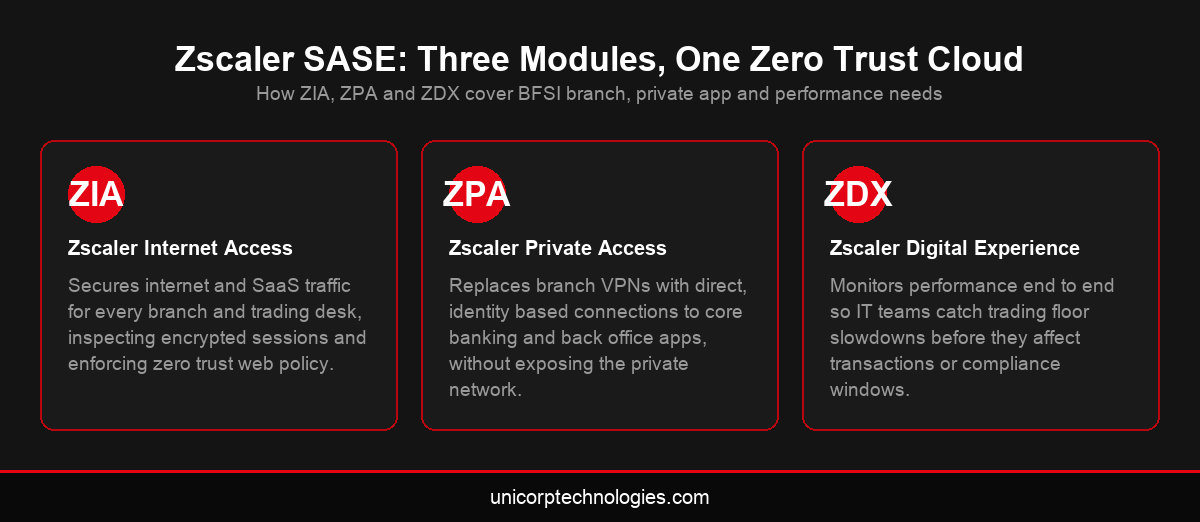 Zscaler ZIA, ZPA and ZDX modules within one SASE security architecture
Bringing the Three Modules Together Under Regulator Scrutiny
UAE cyber security policy is moving from voluntary guidance to mandatory resilience standards. A converged SASE security architecture gives BFSI compliance teams a single policy layer and audit trail across branch traffic, private access and performance, instead of three disconnected point tools to explain to an auditor. Under UAE's national cybersecurity strategy, financial sector expectations have shifted from voluntary best practice toward mandatory resilience, with underlying assurance standards now referenced across banking and government audits.
A fragmented security stack, one VPN vendor, one firewall vendor and a separate monitoring tool, makes an audit harder because each system logs differently and none share a single identity and policy model. Consolidating ZIA, ZPA and ZDX under one Zero Trust cloud gives BFSI security teams a single console for policy, logging and access review, which shortens the evidence gathering that regulator scrutiny demands. This consolidated approach is what most people mean when they talk about SASE security maturity, rather than simply owning a Zscaler license. Unicorp Technologies advises and implements this consolidation for BFSI clients across Abu Dhabi and Dubai, mapping each module to the specific branch, trading floor or back office requirement rather than deploying a generic template built for another industry. As a cyber security Dubai and Abu Dhabi advisory partner, Unicorp scopes each engagement around the institution's own regulatory calendar. Enterprises exploring a broader enterprise security platform beyond SASE can review Unicorp's full range of cyber security capabilities. For a Dubai based BFSI institution weighing cyber security Dubai vendors against a global platform vendor, the practical difference usually comes down to who scopes the rollout around actual branch and trading floor requirements rather than a standard package.
Conclusion
SASE security only pays off for BFSI institutions when ZIA, ZPA and ZDX are implemented as three coordinated modules rather than a single point product. ZIA protects branch internet traffic, ZPA replaces VPN access to trading and back office systems, and ZDX keeps performance visible across a cloud delivered network. Together they give banks and financial institutions a converged Zero Trust cloud that regulators can audit and IT teams can operate, backed by zero trust security services that go beyond a single tool. Unicorp Technologies helps BFSI, enterprise and government clients across the UAE plan and implement this consolidation. Contact Unicorp's security team to scope a SASE roadmap for your institution.