Top SOC Metrics UAE CIOs Should Track in 2026

When a CIO sets out to buy soc services provider near me, dashboards and sales decks are not enough to base that decision on. Real evaluation requires specific, measurable metrics that reveal whether a SOC actually detects and stops threats, or simply generates noise. This guide walks through the six metrics UAE CIOs should demand from any SOC provider, in house or outsourced, before signing a contract or renewing one. Each metric answers a different question about speed, accuracy, and audit readiness.
Key Takeaways
Detection and response speed, MTTD and MTTR, directly predict how much damage a breach causes before it is contained. Alert to incident ratio and false positive rate reveal whether analysts are catching real threats or drowning in noise. Coverage percentage and compliance readiness show whether a SOC provider can support audit requirements across ISO 27001, PCI DSS, and NESA reviews conducted throughout the year.
Why SOC Metrics Matter When Evaluating a Provider
Marketing materials describe capability in general terms. Metrics describe performance in numbers that can be verified, compared across providers, and tracked over time. For a CIO deciding whether to renew or replace a provider, metrics are the only reliable basis for that decision.
Every SOC vendor claims to offer fast detection and expert analysts. Few can produce the numbers to back that claim. A CIO evaluating soc services should ask for actual historical data on detection speed, response time, and alert accuracy, not just a description of the technology stack. This matters more in the UAE than in many markets, because regulated sectors including banking, healthcare, and government face specific audit requirements that a vague service description cannot satisfy. A shortlist of technology security companies should be scored against the same six metrics, side by side, so the comparison is based on evidence rather than the quality of a sales presentation. Providers that hesitate to share this data, or that only offer averages without underlying detail, are usually not equipped to support the reporting a CIO will eventually need to present to a board or regulator. This shift toward evidence based evaluation is relatively new in the UAE market, where procurement decisions have often relied on relationship history or brand recognition rather than verified operational data. CIOs who introduce metric based scoring into vendor reviews frequently uncover real performance gaps that a purely qualitative review would have missed entirely, sometimes only discovering months into a contract that coverage was narrower than originally understood.
The Six Metrics Every UAE CIO Should Track
Six metrics give a complete picture of SOC performance: detection speed, response speed, alert quality, monitoring coverage, false positive rate, and compliance readiness. The infographic below summarizes what each one measures and why it matters to a CIO.
These six metrics work together rather than independently. A SOC that detects threats quickly but responds slowly still allows damage to spread. One that monitors broad coverage but generates excessive false positives will exhaust analyst attention on the wrong alerts. A CIO should request all six figures from any managed service partner under consideration, ideally covering a rolling twelve month period rather than a single strong quarter. Providers that can only supply two or three of the six metrics are likely tracking performance informally rather than through a defined operational process, which is itself a signal worth noting during evaluation.
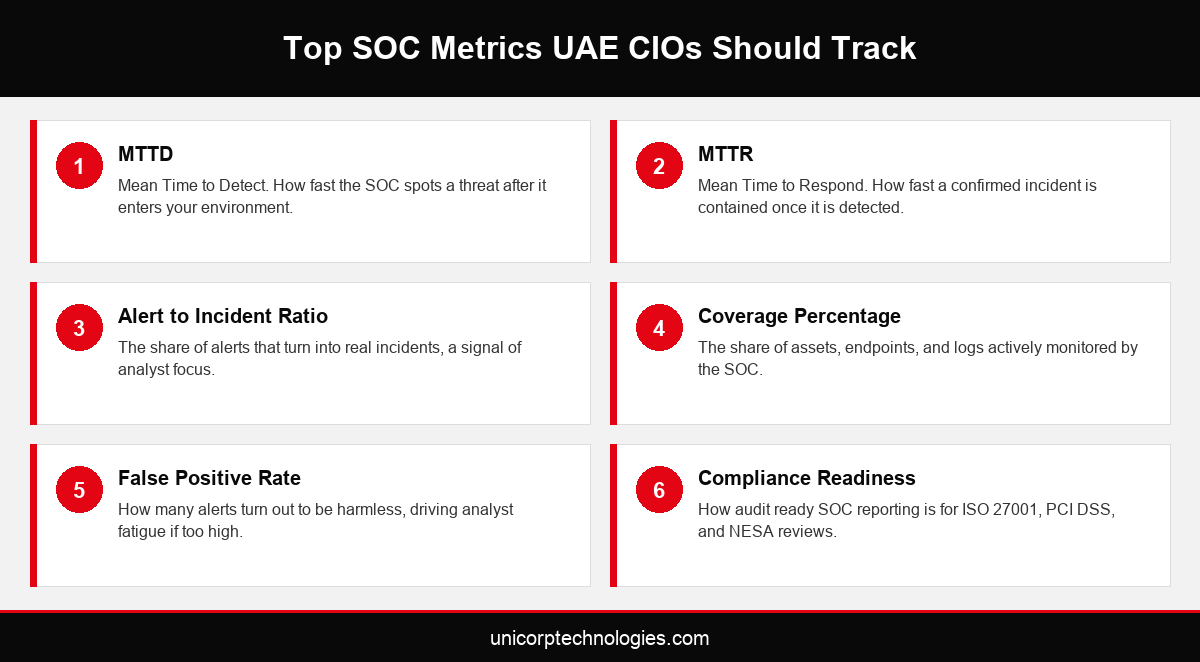
Top SOC metrics UAE CIOs should track including MTTD, MTTR, and compliance readiness
Mean Time to Detect and Mean Time to Respond in Practice
MTTD measures how quickly a SOC identifies a threat after it enters the environment. MTTR measures how quickly a confirmed incident is contained once detected. Together they define how much damage a breach can do before it is stopped.
According to SANS Institute guidance on SOC metrics, organizations should track detection and response times as core operational indicators, not vanity statistics for a quarterly report. A strong SOC should be able to state its median MTTD and MTTR in hours, with data to support the figure. NIST's incident response guidance similarly treats structured, time bound response phases as central to effective incident handling, since delays at any stage compound the eventual cost and scope of a breach. When comparing providers, a CIO should ask how these numbers are calculated, whether they include weekends and holidays, and whether the figures cover the provider's full client base or only its best performing accounts.
A cyber security expert reviewing this data on the CIO's behalf can often spot inconsistencies that a sales conversation alone would miss. It is also worth asking whether MTTD and MTTR are measured from the moment a threat first enters the environment, or only from the moment a SIEM tool generates an alert, since the two starting points can produce very different numbers for what looks like the same metric on paper, and a provider that only counts from alert generation is effectively hiding part of the real detection delay.
Alert to Incident Ratio and False Positive Rate
Alert to incident ratio shows what share of alerts turn into confirmed incidents, a proxy for analyst focus. False positive rate shows how many alerts turn out to be harmless, which drives analyst fatigue when it runs too high.
A SOC that generates thousands of alerts but confirms only a handful of real incidents each month is not necessarily doing a bad job, but the ratio still matters, because it indicates how much noise analysts must filter through to find genuine threats. A high false positive rate is the more concerning signal. It suggests poorly tuned detection rules, and over time it leads to alert fatigue, where analysts become desensitized and start treating urgent alerts with the same casual attention as routine ones. UAE CIOs evaluating a managed service partner should ask specifically how false positive rate has trended over the past year, since a provider actively tuning its detection rules should show steady improvement, while a static or worsening rate suggests the SOC is not investing in ongoing optimization. Both figures are easy for a provider to describe qualitatively and harder to verify without a documented trend line, which is exactly why CIOs should request raw monthly data rather than a single summary percentage covering an entire contract year.
Coverage Percentage and Compliance Readiness for Audits
Coverage percentage shows how much of an organization's infrastructure is actually being monitored. Compliance readiness shows how prepared a SOC's reporting is for ISO 27001, PCI DSS, and NESA reviews.
Coverage percentage is easy to overstate in a sales conversation and hard to verify without asking directly. A CIO should request a breakdown of exactly which assets, endpoints, and log sources are actively monitored, since gaps in coverage are often where breaches originate undetected. Compliance readiness is equally important for UAE enterprises, since ISO 27001, PCI DSS, and NESA reviews all expect documented evidence of continuous monitoring, not a one time assessment. A managed service partner that already produces audit ready reporting saves a CIO significant time during review season, compared to one that has to reconstruct records after the fact. Before signing with any technology security companies on a shortlist, request a sample compliance report to confirm the format actually matches what your auditors expect to see. This single request often reveals more about a provider's real operational maturity than an hour long capability presentation, since a genuinely audit ready SOC can produce the sample quickly, while others need weeks to assemble something presentable.
Conclusion
Choosing a SOC provider should not come down to a sales pitch. The six metrics covered here, MTTD, MTTR, alert to incident ratio, false positive rate, coverage percentage, and compliance readiness, give UAE CIOs a concrete, comparable basis for the decision. Whether you are evaluating a new vendor or benchmarking an existing one, ask for the numbers, not just the promises. A brief conversation with a cyber security expert before signing is usually enough to confirm whether a shortlisted provider can actually deliver on its claims. If you want help scoring a shortlist of providers to buy soc services provider near me with confidence, Unicorp's team can walk through your current metrics and identify where the gaps are. Frequently Asked Questions
Frequently Asked Questions
What is the most important SOC metric for a UAE CIO to track?

How do I choose where to buy soc services provider near me?
What is a good mean time to detect for a SOC?
Why does false positive rate matter so much?
What should coverage percentage actually include?
How does compliance readiness affect SOC provider selection?
Can an in house SOC be measured with these same metrics?
How often should a CIO review SOC performance metrics?
What questions should I ask before signing a SOC contract?
justify the investment internally before finalizing any contract. How do UAE compliance requirements shape SOC metric expectations?