Traditional DLP Fails Against Generative AI Security Risks
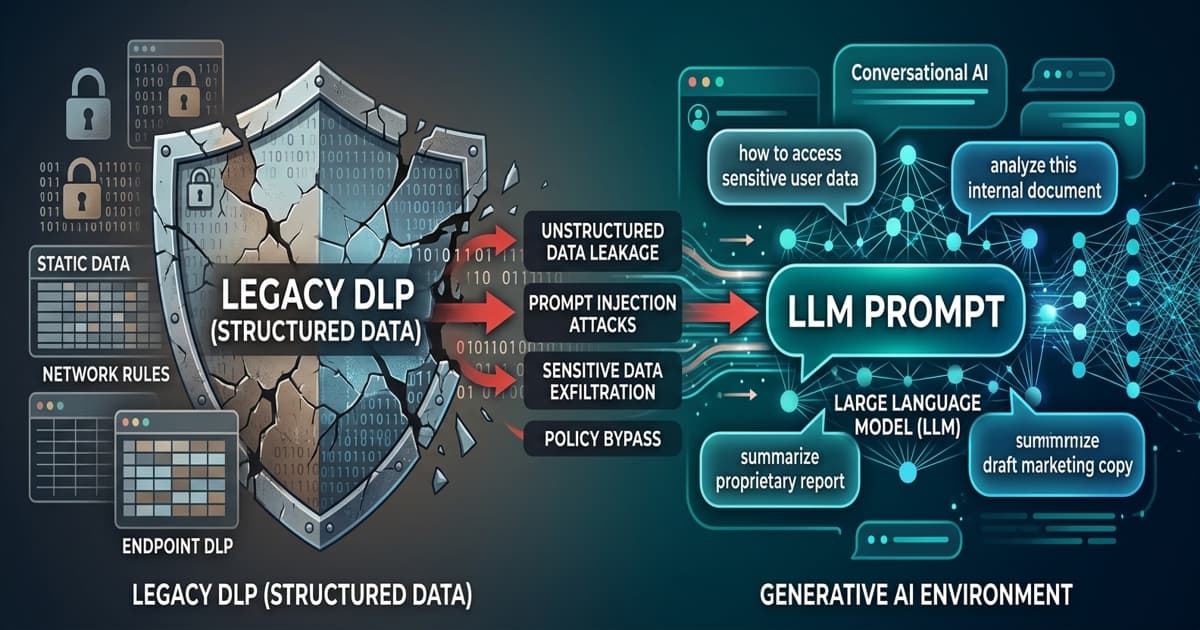
Generative AI security risks are exposing a critical gap in enterprise data protection strategies. Organizations across the UAE and globally are rapidly adopting tools like ChatGPT, Microsoft Copilot, and Google Gemini to accelerate productivity. But as AI usage scales, sensitive enterprise data flows through conversational interfaces, AI prompts, and third-party models in ways that traditional DLP solutions were never designed to detect or control. This article examines why legacy data loss prevention frameworks fall short and what modern AI security architecture must look like for enterprises serious about protecting their data.
Key Takeaways
Traditional DLP tools rely on rigid pattern matching and structured data rules, making them ineffective against prompt-based data disclosure and AI-generated outputs that carry sensitive enterprise information.
Enterprises face emerging risks including shadow AI adoption, intellectual property exposure, and compliance violations when employees interact with generative AI platforms without adequate AI data leakage prevention controls in place.
Modern enterprise AI data protection requires AI-aware security architectures that include runtime monitoring, behavioral analysis, Zero Trust principles, and AI governance frameworks tailored to generative AI workflows.
Why Traditional DLP Cannot Keep Pace with Generative AI
Legacy traditional DLP solutions were architected for a different era of data movement. They were built to detect credit card numbers, social security identifiers, or specific document patterns moving through email gateways, endpoints, or network perimeters. These tools rely on predefined rules, regular expression matching, and structured data fingerprinting.
Generative AI environments do not operate this way. When an employee pastes a product roadmap into a ChatGPT prompt, traditional DLP has no mechanism to understand context, intent, or the semantic value of that content. The data does not match a predefined pattern. It is a natural language input, and the risk lives in meaning, not format.
According to Gartner, by 2027 more than 40 percent of enterprise data leakage incidents will involve generative AI platforms, a category that most existing DLP tools are not equipped to address. The mismatch between legacy tool design and modern AI workflows is one of the most pressing generative AI security risks enterprise security teams face today.
The Core Limitations of Traditional DLP in AI Environments
Understanding why traditional DLP breaks down in AI-driven environments requires examining its foundational design assumptions. These tools assume data has a predictable structure, travels through known channels, and can be identified by content signatures. Generative AI violates all three assumptions simultaneously.
No prompt awareness: DLP tools cannot parse or evaluate AI prompts for sensitive intent. An employee asking an LLM to 'summarize our Q3 financial projections' carries real data risk, but contains no pattern that legacy DLP can flag.
No output inspection: AI-generated responses may synthesize and expose proprietary insights in ways that are invisible to pattern-matching engines. The output risk is as significant as the input risk.
Shadow AI blind spots: Employees accessing unauthorized AI tools from personal browsers or mobile devices completely bypass enterprise DLP controls, creating unmonitored data exposure channels.
No user intent analysis: Traditional tools cannot distinguish between a security researcher testing an AI tool and an employee inadvertently leaking intellectual property through repeated AI interactions.
Multimodal data gaps: Modern generative AI tools process images, voice inputs, code snippets, and documents. Most DLP solutions focus on text and structured file types, missing entire categories of AI-transmitted data.
Emerging Enterprise Risks Driven by Generative AI Adoption
The adoption of generative AI in enterprise environments has introduced a new class of data exposure scenarios that AI DLP strategies must address directly. These risks are not theoretical. They are being observed in organizations across every major sector.
Intellectual property exposure is among the most common risks. Engineers sharing source code with AI coding assistants, legal teams submitting contract language to LLMs for analysis, and finance professionals inputting unreleased earnings data are all real scenarios observed in enterprise environments. Each interaction represents a potential preventing AI data leaks failure point.
Compliance risk compounds the problem. Organizations operating under GDPR, UAE PDPL, HIPAA, or sector-specific financial regulations face direct liability when personal or regulated data enters third-party AI systems without proper data processing agreements or consent mechanisms in place. Sensitive data protection in AI is no longer just a security concern. It is a regulatory imperative.
Shadow AI adoption adds another layer of complexity. A recent IBM survey found that over 60 percent of employees using AI tools at work are doing so without explicit organizational approval or oversight. This unauthorized usage creates data governance gaps that traditional DLP architectures are architecturally incapable of closing.
What AI-Aware Security Architecture Must Include
Moving beyond traditional DLP does not mean abandoning data loss prevention principles. It means evolving them into an AI security architecture that understands the context, behavior, and risk profile of AI interactions at runtime. Enterprises need a multi-layered approach that combines policy, technology, and governance.
AI Runtime Monitoring and Behavioral Controls
AI-aware security platforms must provide real-time visibility into what data is being submitted to AI systems and what outputs are being generated. This requires behavioral monitoring that evaluates user actions in context rather than scanning content for fixed patterns. Runtime controls can flag anomalies such as unusually large data uploads to AI interfaces, repeated submission of similar sensitive content, or access to AI tools from unmanaged devices.
This level of monitoring enables security teams to identify and respond to generative AI security risks before data exposure becomes a reportable incident. It also provides the audit trail necessary to demonstrate regulatory compliance across AI-assisted workflows.
Zero Trust Principles Applied to AI Access
Zero Trust architecture is particularly well-suited to securing enterprise AI adoption. By treating every AI access request as potentially untrusted regardless of the user's location or device, organizations can enforce granular access policies across approved and unapproved AI tools alike. Continuous verification, least-privilege access, and micro-segmentation of AI service connections reduce the attack surface significantly.
Applying Zero Trust to AI environments means every employee interaction with an AI platform is authenticated, authorized, and logged. This approach directly supports enterprise AI data protection by eliminating implicit trust in AI-adjacent workflows. Organizations exploring this approach can also benefit from understanding how Zero Trust and identity risk management apply specifically to AI cybersecurity environments.
AI Governance Frameworks and Policy Controls
Technology controls alone are insufficient without supporting governance structures. Organizations need clear AI usage policies that define which tools are approved, what data classifications are permitted in AI interactions, and what the consequences of policy violations are. These policies must be operationalized through technical enforcement, not just communicated through acceptable use documents.
AI data leakage prevention governance should include data classification integration, so AI security controls automatically apply the right restrictions based on the sensitivity of the data being accessed. Regulated data, intellectual property, and personally identifiable information should each have distinct controls governing their interaction with AI systems.
Building a robust governance framework also requires organizations to assess their overall enterprise security posture. The principles outlined in why an enterprise security platform is critical in the age of AI provide valuable context for organizations designing AI governance structures that align with broader security strategy.
Building a Practical Path Forward for Enterprise AI Data Protection
Enterprises do not need to choose between AI-driven productivity and sensitive data protection in AI environments. The path forward requires a structured transition from legacy DLP thinking to AI-aware data security that operates at the speed and scale of modern AI adoption.
Begin with an AI inventory audit. Identify every AI tool being used across the organization, including sanctioned and unsanctioned applications. Shadow AI discovery tools and network traffic analysis can surface unauthorized usage that security teams may not be aware of.
Next, assess data flows. Map how sensitive data categories are entering AI systems, what happens to that data inside AI models, and where outputs are being stored or shared. This data flow analysis becomes the foundation for building targeted AI DLP controls that address real exposure points rather than hypothetical scenarios.
Invest in AI-native security tools designed specifically for generative AI environments. These platforms understand prompt structures, LLM interaction patterns, and AI output risks in ways that traditional DLP tools fundamentally cannot. Evaluate solutions that offer browser-level AI monitoring, API-layer controls for AI services, and integration with existing SIEM and identity platforms.
Finally, establish a continuous improvement cycle. The generative AI threat landscape is evolving rapidly. Security controls that are effective today may need to be updated quarterly as new AI capabilities and attack patterns emerge. Organizations that build adaptable enterprise AI data protection programs will be better positioned to support innovation while maintaining security and compliance standards.
For enterprises navigating the intersection of regulatory compliance and AI security, exploring how enterprise cybersecurity solutions can be structured to address AI-specific data protection challenges is a valuable starting point for building a resilient security posture.
Conclusion
Generative AI security risks are real, growing, and fundamentally misaligned with the capabilities of traditional DLP solutions. As enterprises in the UAE and across the region accelerate AI adoption, the gap between existing data protection tools and the actual threat landscape will continue to widen unless organizations take deliberate steps to evolve their security architecture. AI-aware monitoring, Zero Trust access controls, data governance frameworks, and behavioral detection are not optional enhancements. They are the core components of a security program capable of protecting enterprise data in a generative AI world. Organizations that invest in these capabilities now will be positioned to innovate confidently while maintaining the trust, compliance, and resilience their business depends on.
Frequently Asked Questions
Why do traditional DLP solutions fail to protect data in generative AI environments?

What are the biggest generative AI security risks enterprises face today?
How does shadow AI adoption create enterprise data protection gaps?
What is AI-aware security architecture and how does it differ from traditional DLP?
How can organizations prevent sensitive data leaks through generative AI tools?
What role does Zero Trust play in enterprise AI data protection?
How should enterprises govern employee use of AI tools to reduce data leakage risk?
Can I Use AI Tools in My Business Without Risking Data Privacy?
Yes, but only when AI is implemented with the right security, governance, and compliance controls. Businesses should ensure that sensitive data is protected through encryption, access controls, secure cloud environments, data residency policies, and continuous monitoring. AI systems should also be governed by clear rules around data usage, storage, and user permissions to prevent unauthorized access or data leakage. Modern enterprise AI deployments increasingly rely on AI security frameworks, identity and access management, and compliance-driven architectures to maintain privacy while enabling innovation.
What data regulations apply to enterprises using generative AI in the UAE?
How Do I Protect My Business Data When Using AI?
Protecting business data while using AI requires a security-first approach. Organizations should implement strong access controls, encrypt sensitive data, establish clear data governance policies, and ensure AI systems comply with industry regulations and privacy requirements. It is also important to control how data is shared with AI models, monitor AI activities, and regularly assess security risks to prevent unauthorized access, data leakage, or compliance violations.
At Unicorp Technologies, we help organizations securely integrate AI through robust cybersecurity frameworks, cloud security controls, identity and access management, and governance strategies that protect critical business data while enabling AI-driven innovation and operational efficiency.