VAPT vs Red Teaming: Strategic Differences

Ask five pentesting companies for a proposal and you will get five documents that look similar and price very differently. The reason is rarely commercial. It is that the word test is doing two completely different jobs. One kind of engagement asks how many exploitable weaknesses exist across a defined estate. The other asks whether a determined adversary can reach something that matters without being stopped. Both are legitimate, both belong in a mature programme, and buying one when you needed the other is the most common and most expensive mistake UAE enterprises make. This guide separates the two, so the brief you write matches the answer your board is actually asking for. Our earlier note on why a proactive security strategy beats reactive patching sets the wider context.
Key Takeaways
-
A vulnerability assessment and penetration testing engagement measures coverage across a declared scope; a red team measures detection and response against an undeclared one, so the two produce entirely different evidence.
-
Red teaming only pays back once you have a functioning monitoring capability. Running one against an estate with no detection produces a story, not a control improvement.
-
Write the brief around the question you need answered, then judge providers on scope discipline, evidence quality and remediation support rather than on day rate alone.
Two Tests, Two Different Questions
The cleanest way to separate the two disciplines is to look at what each one is trying to prove. A penetration test proves that a specific weakness is exploitable. It works through an agreed list of hosts, applications, APIs or wireless segments, and it reports each finding with a severity rating, a reproduction path and a fix. Coverage is the goal. The client wants to know that the scope was worked through properly and that nothing obvious was left behind.
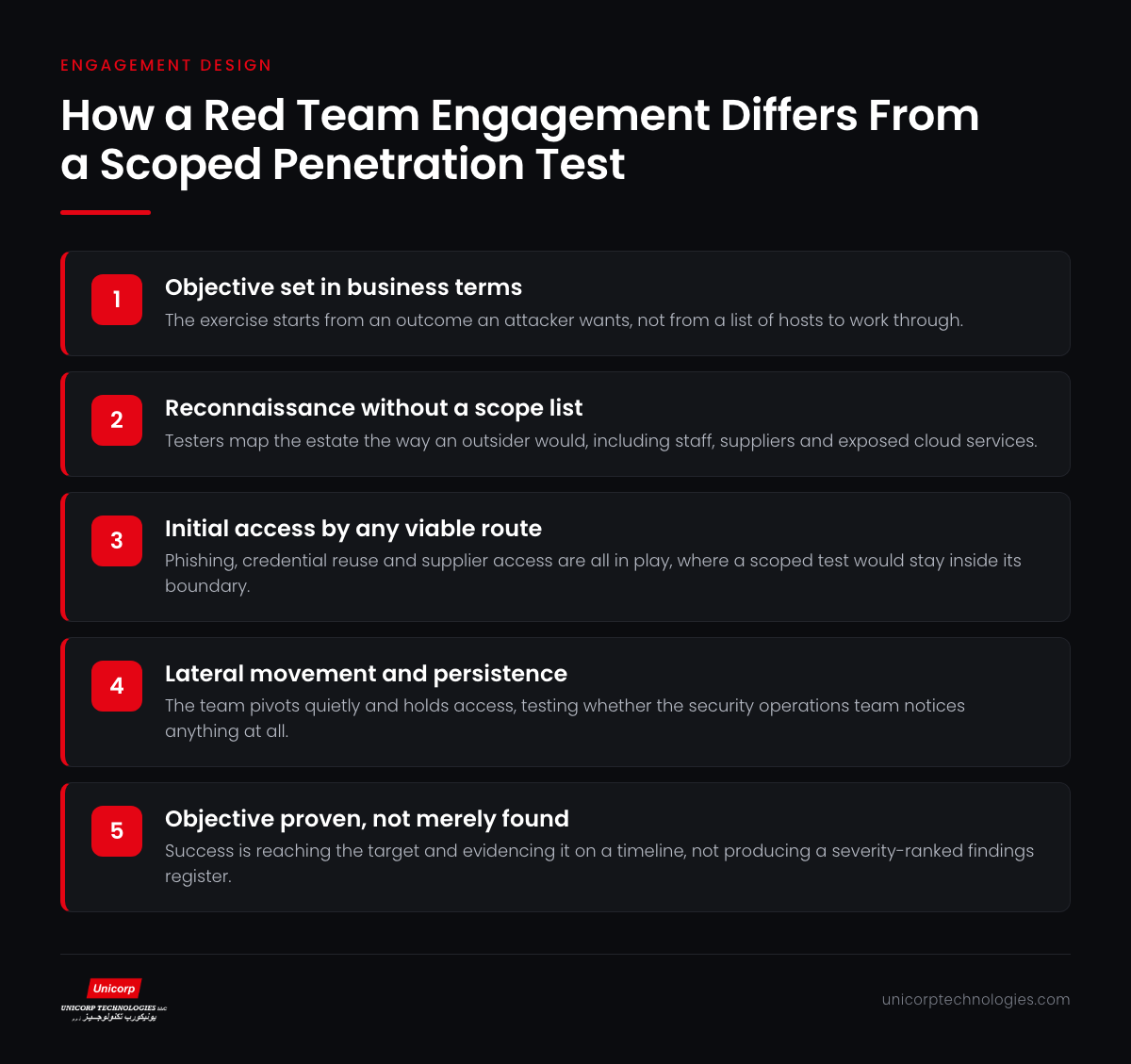
A red team engagement proves something else entirely. It starts from an objective, usually expressed in business terms rather than technical ones, and asks whether that objective can be reached. Reaching a core banking record, moving funds through a payment interface, or extracting a customer database are all typical objectives. The team is free to choose whichever route works. Scope is deliberately loose because the attacker the exercise simulates does not respect scope either.
That difference in framing changes everything downstream. Penetration testing produces a findings register; red teaming produces a narrative with timestamps. Penetration testing is judged on completeness; red teaming is judged on whether the security operations team noticed. Neither is more advanced than the other. They answer different questions and they should be commissioned for different reasons.
For UAE enterprises this distinction matters commercially as well as technically. Regulators and auditors overwhelmingly ask for evidence of the first kind. Boards, after a sector incident, tend to ask for evidence of the second. Understanding which conversation you are in tells you which engagement to buy.
What a VAPT Engagement Actually Covers
Most pentesting companies run a properly scoped assessment through four stages. Scoping fixes the asset list and the testing window. Discovery enumerates what is actually reachable, which routinely differs from what the asset register claims. Exploitation confirms which weaknesses are genuinely usable rather than theoretically present. Reporting translates each confirmed issue into a severity, an impact statement and a remediation step an engineer can act on without a follow-up call.
The value sits in that fourth stage more than anywhere else. A scanner can produce a list. What separates good VAPT Services from an automated report is the manual verification that removes false positives and the business context that raises or lowers a rating. A medium-severity flaw on an internet-facing payment component may matter far more than a high-severity flaw on an isolated internal test host, and only a human tester who understands the estate will say so.
Severity itself should be traceable. Most providers rate against the Common Vulnerability Scoring System, and asking to see the vector string behind each score is a reasonable request. It lets your own team re-derive the rating, argue with it where the environmental metrics differ, and prioritise consistently across reports from different suppliers. Our note on how hidden weaknesses surface during testing walks through what that looks like in practice.
Cadence is the other design decision. Annual testing satisfies most audit requirements and almost nothing else, because estates change weekly. Enterprises getting real value from Pentesting services run a broad assessment once or twice a year and targeted retests after every significant release, migration or acquisition.
What Changes When a Red Team Takes Over
A red team engagement inverts almost every assumption in the paragraph above. There is no host list. There is an objective, a rules-of-engagement document, and a very small group of people inside the client who know the exercise is running. Everyone else, including the security operations team, is expected to treat what they see as real.
The techniques widen accordingly. Phishing, credential reuse against exposed services, supplier access, and in some engagements physical entry all become fair game because a real adversary would use them. Testers map their activity to the publicly maintained adversary technique taxonomy so that the client can compare what was done against what their tooling should have caught, and can see which stages of the intrusion produced no alert at all.
The output is a timeline rather than a register. It records when each action was taken, what telemetry it should have generated, and whether anyone reacted. That timeline is the deliverable your detection engineering team will work from for the next two quarters, and it is why the exercise is worth its considerably higher cost.
The prerequisite is uncomfortable but unavoidable. If your organisation has no monitoring capability, a red team will succeed quickly, prove nothing you did not already suspect, and leave you with a report you cannot act on. Build detection first, then test it.
Scope, Cost and Calendar Compared
Duration is the first visible difference when you compare quotes from pentesting companies. A focused application assessment runs one to three weeks. A red team engagement against a mid-sized enterprise typically runs six to twelve, because reconnaissance alone consumes time that a scoped test skips entirely. Budget follows duration, and the gap is usually several multiples rather than a percentage.
Disruption differs too. Assessments are announced, scheduled around change freezes and coordinated with application owners. Red teams are not, which means the organisation must accept that its own responders will spend real hours on what turns out to be an exercise. That cost is intentional. It is the only honest way to measure response.
Reporting audiences diverge as well. An assessment report goes to engineering leads who will close findings. A red team report goes to the security leadership and often to the board, because its conclusions are about capability rather than configuration. Enterprises that send the wrong report to the wrong audience get either a technical document nobody acts on or a narrative nobody can implement.
Finally, the two carry different regulatory weight. Sector supervisors in the UAE consistently ask for evidence of periodic technical assessment. Very few mandate adversarial simulation. If a filing deadline is driving the purchase, the scoped engagement is almost certainly what is required.
How to Brief the Right Provider
Start the brief with the question, not the method. Write down what you need to be able to say when the work finishes. If the sentence is we have tested every internet-facing service and closed what we found, you are buying an assessment. If it is we know how far an attacker gets before we notice, you are buying a red team. Providers can then price against a real objective rather than guessing.
Judge proposals from competing pentesting companies on three things. First, scope discipline: does the document state clearly what is in, what is out and what happens when something unexpected is found. Second, evidence quality: ask for a redacted sample report and check whether findings carry reproduction steps a developer could follow. Third, remediation support: confirm whether retesting is included and how long the window lasts, because a finding that is never retested is a finding that will reappear.
Credentials are worth checking but should not decide the outcome on their own. Certifications tell you a tester has passed an exam. The sample report tells you how they think. Among the best pen testing companies operating in the region, the differentiator is almost always the quality of written analysis rather than the toolset, which is broadly the same everywhere.
Control catalogues such as NIST SP 800-53 are a useful cross-reference when you want to check that a proposal covers the assessment activities your own policy already commits you to. Independence matters when the same firm also sells you controls. That is not disqualifying, and integrated delivery has real advantages, but the engagement letter should make clear that findings will be reported regardless of which product they implicate. You can see how our own security practice is structured and where the separation sits.
A Sequencing Model That Works
Most UAE enterprises get the best return from a three-phase sequence rather than a single purchase, and the better pentesting companies will say so before quoting. Phase one is broad assessment across the external estate and the crown-jewel internal applications, repeated on a fixed cadence and retested after each release. This is the hygiene layer and it should never stop.
Phase two is detection engineering. Take the techniques that appeared in your assessment reports, confirm that your monitoring stack generates telemetry for each, and write the detections you are missing. This phase produces no external report and is therefore the one most often skipped, which is precisely why so many red team exercises end early.
Phase three is adversarial simulation, run once the first two are in place. At that point the exercise measures something real, and the timeline it produces feeds straight back into phase two. Enterprises adopting AI-driven services should extend the same sequence to those systems; the identity risks introduced by model integrations behave differently from classic application flaws and need their own test cases.
The practical conclusion is simple. Brief pentesting companies for coverage and compliance, build detection with what it tells you, and commission the red team when you are ready to be measured rather than mapped. If you are deciding which of the three you need next, our team can review your current testing programme and tell you where the gap actually sits.