Why 24/7 Threat Monitoring Is No Longer Optional
Most successful breaches do not happen at 10 a.m. on a Tuesday. They happen at 2 a.m. on a Saturday, when the office is empty and nobody is watching the console. This is why cyber threat intelligence providers now treat after hours coverage as a core requirement, not an add on. UAE enterprises in banking, healthcare, and government increasingly need 24/7 SOC coverage to close this gap. This article explains why the monitoring gap is the most common entry point for attackers, what delayed detection actually costs, and how continuous threat intelligence paired with a 24/7 SOC closes it for good, permanently.
Key Takeaways
Attackers deliberately time intrusions for nights, weekends, and public holidays when in house teams are offline. Delayed detection materially increases breach cost, and the global average time to identify and contain a breach is still measured in months, not hours.
Continuous threat intelligence combined with a 24/7 SOC closes the coverage gap without requiring a business to staff its own around the clock team from scratch.
The After Hours Blind Spot
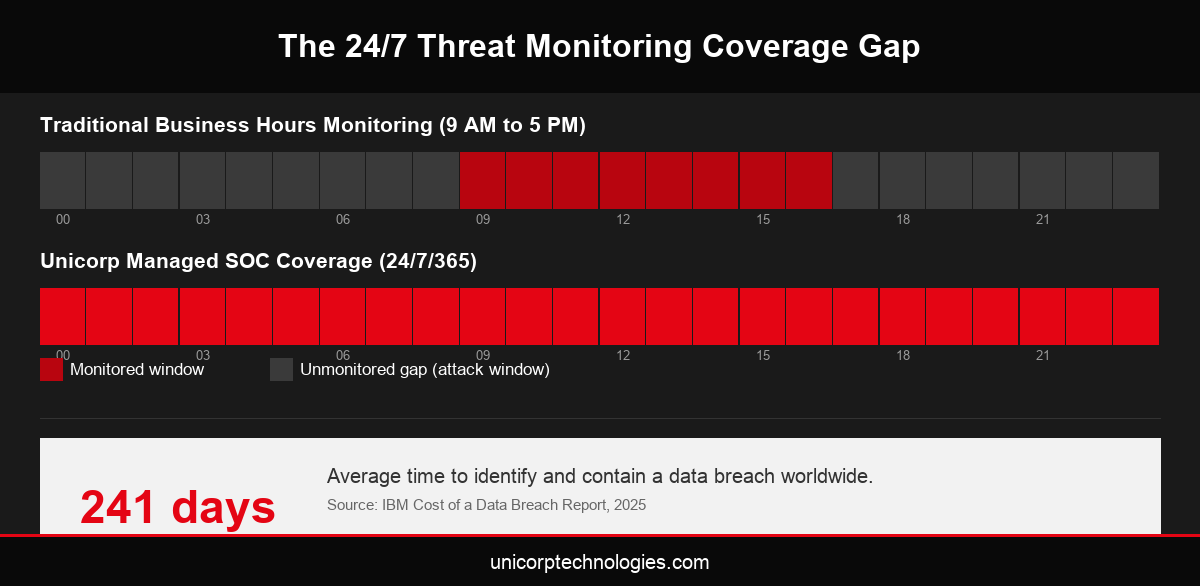
Cybercriminals study their targets before striking, and business hours monitoring creates a predictable window they can plan around. Attacks launched outside 9 to 5 face far less resistance, because the people who would normally notice unusual activity are not watching. The infographic below shows how much of the week goes unmonitored under a traditional schedule.
Traditional business hours monitoring covers roughly 40 hours out of the 168 hours in a week. That leaves well over 70 percent of the week effectively unwatched unless a business has invested in continuous coverage. Attackers know this. Ransomware groups and opportunistic intruders routinely time initial access for Friday evenings or the start of a long public holiday weekend, because they know detection will be delayed until staff return. For UAE businesses, this includes national holidays and Eid breaks, when offices close for several consecutive days at once. A gap of even 48 hours gives an attacker enough time to move laterally across a network, establish persistence, and begin exfiltrating data before anyone notices. This is the core argument for treating round the clock coverage as a baseline requirement for soc services rather than a premium upgrade reserved for the largest enterprises. Weekend staffing shortfalls compound the problem further, since many IT teams reduce headcount on Fridays and Saturdays even when the rest of the business keeps operating, leaving digital infrastructure with the least coverage precisely when transaction volume and remote access activity remain high.
What Delayed Detection Actually Costs
The longer a breach goes undetected, the more it costs to contain and the more damage it does before anyone intervenes. Independent industry research consistently ties detection speed directly to financial outcomes, not just technical severity.
According to IBM's 2025 Cost of a Data Breach Report, organizations took a global average of 241 days to identify and contain a breach, made up of 181 days to identify and 60 days to contain. Breaches detected and contained before the 200 day mark cost an average of 3.87 million dollars, while those that took longer cost 5.01 million dollars, a premium of more than a million dollars tied directly to detection speed. These figures are global, but the same logic applies to UAE enterprises handling sensitive financial or patient data, where a slow detection window increases both the direct cost of the incident and the regulatory exposure that follows once local authorities are notified. Organizations that already run managed soc services tend to detect incidents in hours rather than months, because analysts are actively reviewing correlated alerts instead of waiting for a scheduled log review to surface something unusual weeks after the fact.
Why UAE Enterprises Are Especially Exposed
UAE businesses sit at the center of a fast growing digital economy, which makes them an attractive target, while national holiday patterns create predictable windows attackers can plan around in advance. Banking, healthcare, and government entities in the UAE are frequent targets because of the volume of sensitive data they hold and their role in critical infrastructure. Regulators have responded by tightening expectations. The UAE Cyber Security Council's national strategy has shifted cybersecurity compliance from a voluntary posture to an expected baseline across regulated sectors, with continuous monitoring increasingly treated as a minimum standard rather than best practice. For organizations still relying on manual log review during business hours, this creates a widening gap between what regulators expect and what internal teams can realistically deliver without external support. Managed security services exist specifically to close this gap, pairing local UAE context with always on coverage that a purely internal team struggles to sustain on its own. Sector specific expectations are rising too. Banks are expected to demonstrate continuous transaction monitoring, hospitals must protect patient records around the clock under data protection obligations, and government entities face some of the strictest reporting timelines of any sector, all of which point toward the same conclusion: monitoring that pauses overnight no longer meets the bar regulators are setting.
How Continuous Threat Intelligence Closes the Gap
Cyber threat intelligence providers track indicators of compromise, malicious infrastructure, and emerging attack patterns before they reach a client's network, feeding that context into the SOC's detection rules in real time. Continuous threat intelligence is what separates a reactive SOC from a proactive one. Rather than waiting for an alert to fire inside the network, cyber threat intelligence providers monitor external sources, including known malicious IP addresses, phishing infrastructure, and forums where stolen credentials are traded, and feed that intelligence directly into detection rules. This means a SOC analyst can flag a login attempt from an address already linked to active campaigns elsewhere, before it becomes a confirmed breach. Combined with a 24/7 SOC, this turns detection from a purely internal exercise into one informed by what is happening across the wider threat landscape. Unicorp's predictive threat detection approach applies this model directly to UAE clients, correlating external intelligence with internal log data around the clock rather than relying on either source alone.
Building Always On Coverage Without an Internal Team
Most UAE organizations cannot justify hiring and rostering a full internal security team purely for after hours coverage. A managed enterprise security platform delivers the same continuous protection without the recruitment burden.
Building an internal 24/7 SOC requires at minimum three to four analysts per shift rotation, plus a manager, plus ongoing training to keep pace with new threats, a cost most mid size UAE businesses cannot justify on their own. An outsourced model spreads this cost across many clients while still delivering dedicated, always on coverage. This is typically delivered through an enterprise security platform that unifies SIEM data, threat intelligence feeds, and analyst workflows into one system, rather than stitching together multiple point tools. For a growing UAE business, this is usually the fastest way to close the after hours gap without the multi year investment required to build the same capability internally from the ground up. It also gives smaller IT teams access to network security solutions and threat coverage that would otherwise require a much larger internal budget to replicate. Procurement teams evaluating providers should ask directly how many hours per week a proposed contract actually covers, since some vendors quietly limit round the clock claims to alert generation only, leaving investigation and containment for business hours regardless of when the alert first fired.
Conclusion
After hours and weekend gaps remain the most common way breaches go undetected. The data is consistent: slower detection means higher cost and more damage before anyone intervenes. Cyber threat intelligence providers combined with a 24/7 SOC close this gap by watching continuously rather than periodically. Pairing this with managed security services and modern network security solutions gives a UAE business one coordinated defense instead of scattered point tools. If your current monitoring stops when your office closes, that is the single biggest risk in your security posture today. Talk to Unicorp about extending coverage to every hour of the week, not just business hours.
Frequently Asked Questions
Why is 24/7 threat monitoring important for UAE businesses?

What do cyber threat intelligence providers actually monitor?
How long does it typically take to detect a breach?
Do weekends and holidays really increase security risk?
What is the difference between threat intelligence and SOC services?
Can network security solutions alone prevent after hours breaches?
How do UAE regulations affect after hours monitoring requirements?
What is an enterprise security platform?
Who leads Unicorp's security monitoring team?
Is 24/7 monitoring only necessary for large enterprises?