Why Identity and Access Management Is the New Security Perimeter
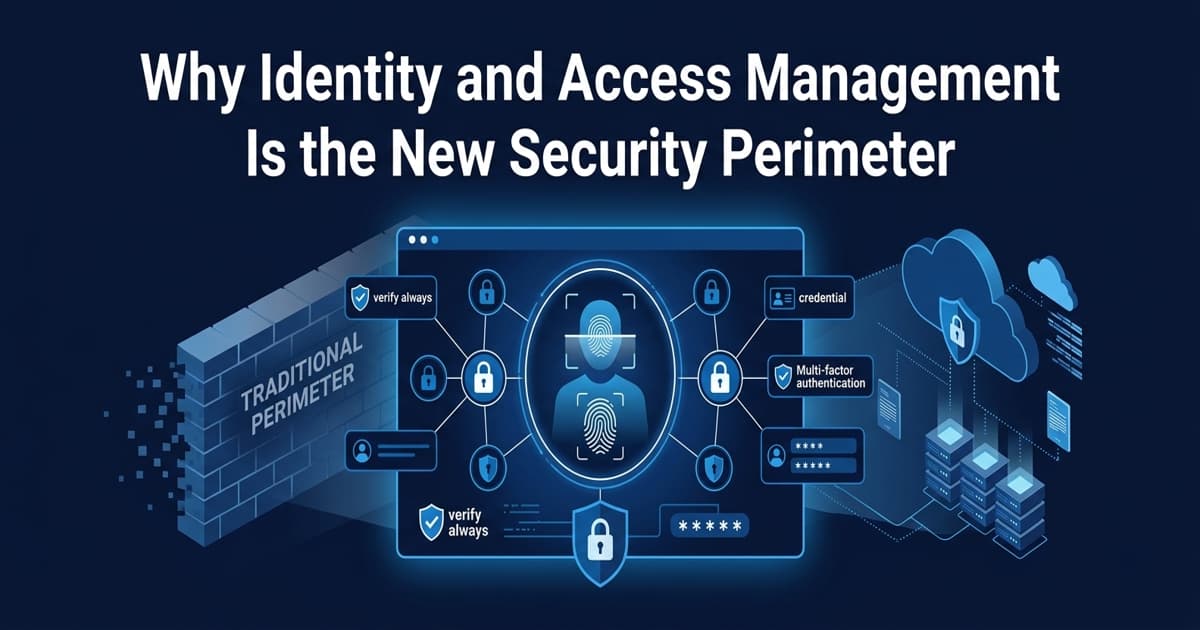
Identity and access management is no longer a background IT function. It has become the primary battleground of modern cybersecurity. As organizations expand into cloud platforms, remote work environments, SaaS applications, and third-party ecosystems, the traditional network perimeter has dissolved. Attackers no longer need to break through firewalls. They simply compromise credentials. According to the Verizon Data Breach Investigations Report, over 80 percent of hacking-related breaches involve stolen or weak credentials. This reality has elevated IAM to the center of enterprise security strategy.
Key Takeaways
Identity and access management has replaced the network perimeter as the primary security boundary for modern enterprises operating in cloud and hybrid environments.
Weak identity governance, excessive privileges, and credential theft are among the leading causes of enterprise data breaches, making privileged identity management a critical priority.
Adopting IAM within a zero trust security services framework allows organizations to enforce least-privilege access, reduce attack surfaces, and meet regulatory compliance requirements across sectors.
What Is Identity and Access Management and Why Does It Matter Now?
Identity and access management is the framework of policies, processes, and technologies that controls who can access what within an organization's digital environment. IAM ensures that the right individuals access the right resources at the right time for the right reasons. It covers user authentication, authorization, role-based access control, single sign-on, multi-factor authentication, and lifecycle management of user accounts.
The urgency around IAM has intensified because digital environments have grown dramatically more complex. A typical enterprise today manages identities across on-premise systems, multiple cloud providers, SaaS platforms, contractor accounts, and machine-to-machine interactions. Each identity represents a potential entry point for attackers. Without a structured identity and access management strategy, organizations are operating with invisible exposure they cannot measure or control.
The IBM Cost of a Data Breach Report consistently finds that breaches involving stolen credentials take significantly longer to detect and contain, increasing total breach costs. This data confirms that identity is not just a security concern. It is a direct business risk with measurable financial consequences.
How the Traditional Perimeter Broke Down
For decades, enterprise security relied on a castle-and-moat model. The network perimeter defined what was trusted and what was not. Employees worked inside a defined boundary protected by firewalls, VPNs, and intrusion detection systems. That model assumed a relatively stable, enclosed environment.
Cloud adoption, remote work, and SaaS proliferation have fundamentally changed that assumption. Today, employees access corporate resources from personal devices, home networks, coffee shops, and international locations. Applications run across multiple cloud providers simultaneously. Third-party vendors require ongoing access to internal systems. In this environment, the concept of a trusted internal network no longer holds.
Attackers have adapted to this reality. Phishing campaigns, credential stuffing attacks, and social engineering are specifically designed to compromise user identities rather than technical infrastructure. Once an attacker gains valid credentials, they can move laterally through systems while appearing as a legitimate user. This is why zero trust security services have become essential. The zero trust principle of 'never trust, always verify' directly addresses the identity risk that the perimeter model ignored. Organizations exploring this shift can benefit from understanding how to build unbreakable security architectures designed for today's distributed enterprise.
The Business Risks of Weak Identity Governance
Inadequate identity and access management creates vulnerabilities that attackers actively exploit. The risks fall into several distinct categories that security leaders must understand and address.
Privilege creep occurs when employees accumulate access rights over time that exceed what their role requires. Individuals change roles, take on temporary projects, or move between departments. Without regular access reviews, accounts retain excessive permissions indefinitely. This creates a massive attack surface that a single compromised credential can exploit.
Privileged identity management addresses the heightened risk posed by accounts with administrative or elevated access. Privileged accounts can modify system configurations, access sensitive data stores, and disable security controls. According to the Cybersecurity and Infrastructure Security Agency (CISA), compromised privileged accounts are a common factor in major ransomware and supply chain attacks. Managing these accounts through dedicated privileged access management solutions, session monitoring, and just-in-time access provisioning is no longer optional for enterprise environments.
Orphaned accounts represent another significant exposure. When employees leave an organization or change roles, their accounts are often not promptly deprovisioned. These inactive but valid accounts are attractive targets because they may not be monitored actively. A strong IAM framework automates deprovisioning and flags dormant accounts for review.
Third-party and machine identities further complicate the risk landscape. Contractors, partners, and service providers require access to specific systems to deliver their services. Machine identities, including service accounts, APIs, and automation scripts, often carry elevated permissions with minimal oversight. Organizations that lack visibility into these non-human identities face significant blind spots in their security posture. Exploring how privileged access management is being redefined for modern enterprises offers valuable context for addressing this challenge.
IAM as the Foundation of Zero Trust Security
Zero Trust is not a product. It is a security philosophy built on the principle that no user, device, or system should be trusted by default, regardless of network location. Identity and access management is the operational foundation that makes Zero Trust possible.
In a Zero Trust architecture, every access request is evaluated based on the identity making the request, the device being used, the location, the time, and the sensitivity of the resource being accessed. This requires robust identity verification at every step. Multi-factor authentication, continuous session monitoring, adaptive access policies, and least-privilege enforcement are all IAM capabilities that directly enable Zero Trust outcomes.
Zero trust remote access is a practical application of this model. Rather than relying on traditional VPN connections that grant broad network access, zero trust remote access evaluates each session individually and grants only the specific access the user needs at that moment. This approach dramatically reduces the blast radius of a compromised credential and limits lateral movement within the network.
For organizations in regulated industries such as finance, healthcare, and government, the alignment between IAM and Zero Trust also supports compliance with frameworks including ISO 27001, NIST SP 800-207, and UAE-specific data protection regulations. Unicorp Technologies helps organizations implement these frameworks as part of a comprehensive cyber security solutions strategy tailored to regional compliance requirements.
How IAM Supports Compliance and Operational Efficiency
Regulatory compliance is a major driver of IAM adoption across UAE enterprises. Financial services firms must comply with Central Bank of UAE cybersecurity requirements. Healthcare organizations face obligations under data protection laws. Government entities operate under the National Cybersecurity Strategy. All of these frameworks share a common requirement: organizations must demonstrate that access to sensitive systems and data is controlled, auditable, and reviewed regularly.
Identity and access management provides the audit trails, access logs, and governance workflows that compliance teams need to demonstrate control. Role-based access control ensures that employees can only access data relevant to their function. Automated provisioning and deprovisioning reduce the window during which inappropriate access exists. Periodic access certification campaigns provide documented evidence that access rights have been reviewed and validated.
Beyond compliance, IAM improves operational efficiency. IT teams spend significant time managing password resets, access requests, and account lockouts. Self-service identity portals, single sign-on, and automated workflows reduce this administrative burden while simultaneously improving security. When users can access all required systems through a single authenticated session, productivity increases and friction decreases. Organizations looking to align security with operational goals can explore how proactive cybersecurity approaches in the UAE support ongoing identity governance programs.
The Role of AI and Automation in Modern IAM
Artificial intelligence is transforming how organizations manage identity security. Traditional IAM systems relied on static rules and manual reviews. Modern platforms integrate AI and machine learning to analyze behavioral patterns, detect anomalies, and respond to identity-based threats in real time.
AI secure access solutions can identify when a user's access behavior deviates from their established baseline. If an account suddenly accesses an unusual volume of files, logs in from an unfamiliar geography, or attempts to escalate privileges outside normal hours, AI-driven systems can trigger step-up authentication, alert the security team, or automatically restrict the session. This capability is the foundation of Identity Threat Detection and Response, a growing discipline within enterprise security that combines IAM telemetry with threat intelligence.
Automation also plays a critical role in identity lifecycle management. AI-powered provisioning engines can analyze job role changes and automatically adjust access rights without manual intervention. This reduces the risk of privilege creep while accelerating onboarding processes. As organizations scale their digital operations, AI-driven IAM becomes essential for maintaining security governance at enterprise speed. For a broader look at how artificial intelligence is reshaping enterprise security, the analysis of AI and enterprise cybersecurity evolution provides important strategic context.
Emerging Identity Security Trends Shaping the Future
The identity security landscape is evolving rapidly. Several trends are redefining how organizations approach identity and access management over the next three to five years.
Passwordless authentication eliminates the reliance on static passwords, replacing them with biometrics, hardware tokens, and cryptographic credentials. This approach removes the most common attack vector in credential theft and significantly reduces phishing risk.
Identity Threat Detection and Response (ITDR) is emerging as a dedicated security capability. Organizations are deploying ITDR tools that monitor identity infrastructure, detect suspicious access patterns, and respond to identity-based attacks before they escalate.
Machine identity management is growing in importance as organizations deploy more APIs, microservices, containers, and automation scripts. Managing the lifecycle and privileges of machine identities is becoming as critical as managing human user accounts.
Decentralized identity models, built on blockchain and cryptographic standards, are emerging as long-term alternatives to centralized identity directories. These models give users greater control over their own credentials while reducing the value of centralizing identity data stores as attack targets.
Continuous access evaluation replaces static session tokens with real-time policy enforcement. Access rights are re-evaluated dynamically throughout a session based on current risk signals rather than being granted once at login.
Organizations that invest in understanding and preparing for these trends will be better positioned to manage identity risk as digital environments continue to evolve. Staying current with the future of cyber services in UAE provides forward-looking perspective for security leaders planning their IAM roadmap.
Building a Stronger Identity Security Strategy with Unicorp Technologies
Identity and access management is no longer a compliance checkbox or an IT administration task. It is the strategic core of modern enterprise cybersecurity. As the attack surface continues to expand and identity-based threats grow more sophisticated, organizations that invest in robust IAM frameworks will be significantly better protected than those that rely on outdated perimeter controls.
Unicorp Technologies brings deep expertise in identity security, Zero Trust architecture, privileged identity management, and managed security services to enterprises across the UAE. From initial assessments and architecture design to implementation and ongoing governance, Unicorp helps organizations build identity security programs that align with their business objectives, regulatory requirements, and risk tolerance. The enterprise security platform capabilities that Unicorp delivers enable organizations to centralize identity visibility, enforce consistent access policies, and respond to threats with speed and confidence.
Whether your organization is beginning its IAM journey or looking to mature an existing program, Unicorp Technologies offers the expertise and technology partnerships needed to make identity security a genuine competitive advantage. Connect with the Unicorp team to assess your current identity posture and develop a roadmap for stronger, smarter access control across your entire digital environment.
Frequently Asked Questions
What is identity and access management in simple terms?

Why has identity become the new security perimeter?
What is privileged identity management and why is it critical?
How does IAM support zero trust security services?
What is zero trust remote access and how does it differ from VPN?
How does AI secure access improve identity security outcomes?
What compliance frameworks does IAM support for UAE organizations?
What is an enterprise security platform in the context of IAM?
What are the biggest identity security risks organizations face today?
How do managed security services help organizations maintain strong IAM programs?