Zero Trust Security Services: Protecting AI, Data, and Users at Scale
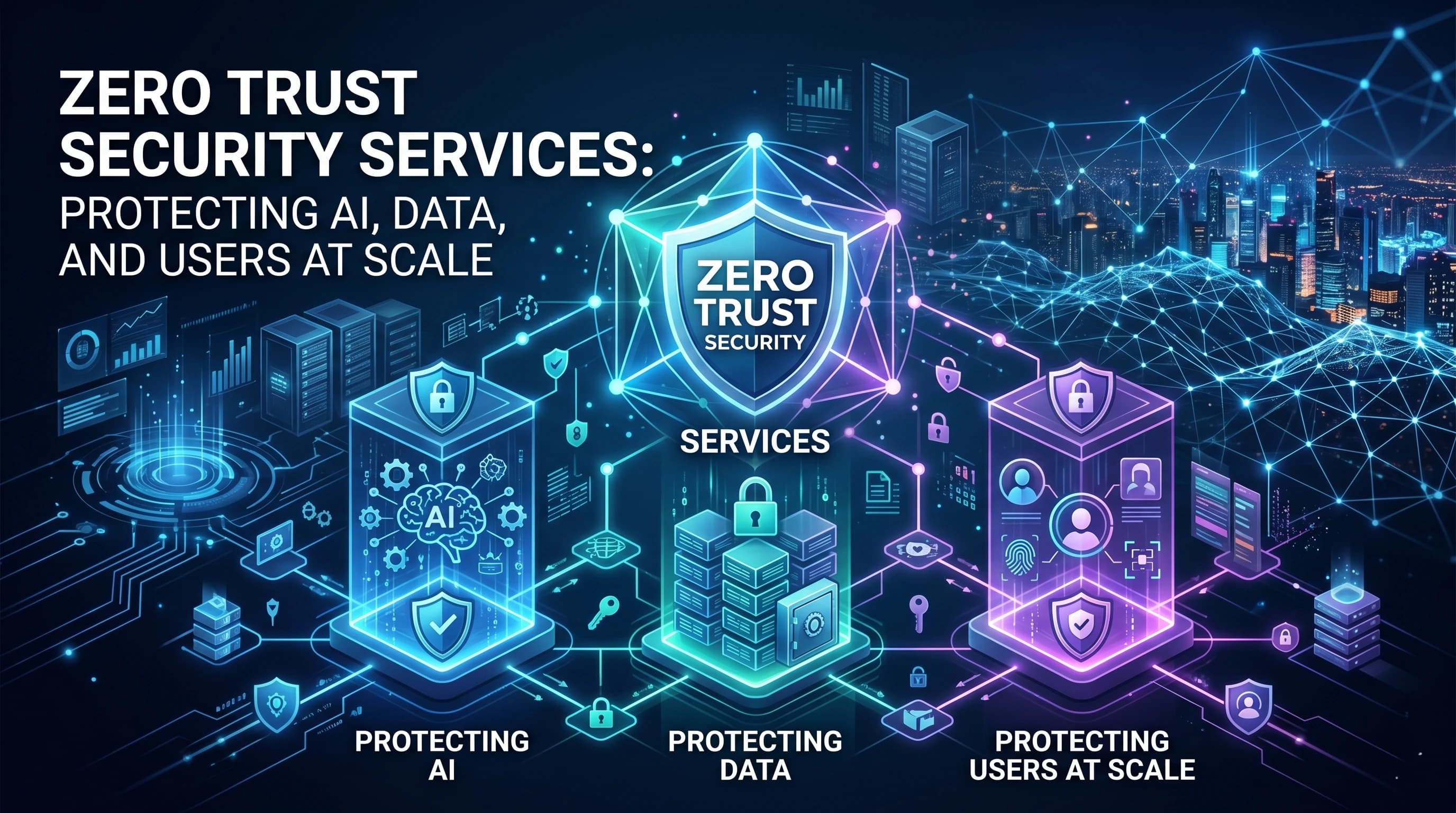
Zero Trust Security Services have shifted from a best-practice recommendation to an operational necessity. According to Zscaler's ThreatLabz 2026 AI Security Report, enterprise AI activity surged 91% year-over-year, and median breach time now stands at just 16 minutes. More alarming: 410 million data loss prevention violations were traced directly to ChatGPT usage alone. Yet Gartner reports that only 10% of large enterprises will have a mature Zero Trust programme by 2026, up from less than 1% in 2023. When employees interact daily with dozens of unvetted AI tools, sensitive data moves across boundaries that traditional security architectures were never designed to govern.
Key Takeaways
Zero Trust Security Services are now the baseline architecture for enterprises navigating AI-driven risk, not an advanced upgrade.
Zscaler's Zero Trust Exchange addresses three critical layers: AI Security, ZTNA, and Zero Trust Cloud, each designed to eliminate blind spots in modern enterprise environments.
UAE enterprises in BFSI and government sectors face the highest exposure and stand to gain the most from structured Zero Trust deployment with a trusted regional partner like Unicorp Technologies.
Organisations with mature Zero Trust implementations experience 50% fewer breaches and save an average of $1.76M per incident compared to those without, according to Forrester and IBM research.
Why Traditional Security Fails in an AI-Driven Enterprise
Perimeter-based security was engineered for a different era. Firewalls and VPNs operate on a castle-and-moat assumption: trust everything inside the network, verify nothing once inside. That model made sense when employees worked on-premises and applications lived in data centres. In 2026, neither assumption holds.
The IBM Cost of a Data Breach Report 2024 puts the average breach cost at $4.88 million globally. Three structural failure points are driving this figure upward in AI-intensive environments.
Shadow AI: The Invisible Threat Inside Your Organisation
Employees now access dozens of AI tools outside approved IT channels. This Shadow AI problem means sensitive financial models, customer records, and proprietary data are routinely pasted into unmanaged AI applications. Security teams have no visibility and no control. Traditional DLP tools were built to monitor data movement at the edge, not to inspect what a user inputs into a browser-based AI assistant at 2 pm on a Tuesday.
Addressing this requires AI data leakage prevention capabilities that operate inline, inspecting transactions in real time regardless of the application or device. You can learn more about why traditional DLP fails against generative AI security risks and why a new approach is essential for enterprise teams.
Lateral Movement After Perimeter Breach
Once an attacker bypasses the perimeter, a flat network offers almost no resistance. Lateral movement, the ability to pivot from one compromised asset to another, is now a standard post-breach technique. With AI-powered attacks, that movement happens in minutes, not hours. Microsegmentation and least-privilege access, both core tenets of Zero Trust, directly interrupt this pattern by ensuring that even authenticated users cannot freely roam the environment.
What Zero Trust Security Services Actually Mean at Enterprise Scale
Zero Trust is not a product. It is an architectural philosophy defined by a single operating principle: never trust, always verify, and enforce least-privilege access at every interaction. Forrester Research, which coined the term in 2010, found that organisations with mature Zero Trust implementations experience 50% fewer breaches and reduce breach costs by an average of 43%. NIST Special Publication 800-207 codifies the authoritative framework, covering the five pillars of Zero Trust Architecture: identity, devices, networks, applications, and data.
At enterprise scale, this means continuous verification of every user, device, and workload, regardless of whether they sit inside or outside the corporate network. The Zscaler Zero Trust Exchange operationalises this across three integrated modules: AI Security, ZTNA, and Zero Trust Cloud. Together, they replace the implicit trust of legacy perimeter models with contextual, policy-driven access decisions made in real time.
For enterprises evaluating where to begin, the Zero Trust Security Services practical starting guide for UAE enterprises provides a structured entry point for assessing your current posture and identifying priority deployment areas.
Protecting AI, Data, and Users: The Three Layers That Matter
Layer One: AI Security and Governing AI Traffic
Zscaler AI Protect inspects and governs AI and machine learning traffic across enterprise environments. It identifies which AI tools employees are accessing, classifies the sensitivity of data being shared, and enforces policies that block unauthorised transmission before it leaves the organisation. With 410 million DLP violations traced to ChatGPT usage in Zscaler's 2026 report, the business case for inline AI traffic inspection is no longer theoretical.
This capability also addresses the growing risk of AI data leakage prevention at the application layer, where conventional endpoint controls have no jurisdiction. Governing AI usage is now a compliance requirement, not just a security preference.
Layer Two: Data Security and Zero Trust Posture Management
Inline DLP within the Zero Trust Exchange classifies and controls sensitive data flows across every channel: web, cloud applications, email, and endpoints. Gartner predicts that by 2028, 50% of organisations will adopt a zero-trust posture for data governance specifically because of the proliferation of unverified AI-generated data. The enterprises that build this capability now will be positioned to meet those governance requirements without retrofitting.
Posture management continuously evaluates whether users, devices, and workloads meet defined security thresholds before granting access. A device that passes morning authentication may fail a posture check at noon if it downloads a suspicious package. Access is adjusted dynamically, not at the next login cycle. For a deeper look at how cybersecurity compliance in the UAE in 2026 is reshaping data governance obligations across sectors, this is a foundational read for CISO teams.
Layer Three: ZTNA and Secure Access for Distributed Users
Zero Trust Network Access (ZTNA) replaces the legacy VPN with identity-centric, application-level access. Where VPN grants broad network access once a user authenticates, ZTNA grants access only to the specific application or resource a verified user needs at that moment. For hybrid and remote workforces, this is not a marginal improvement; it eliminates the network-level exposure that VPN inherently creates.
The CISA Zero Trust Maturity Model provides a structured benchmark for organisations implementing ZTNA, mapping progression across identity, devices, networks, applications, and data. For UAE enterprises managing hybrid teams across Abu Dhabi, Dubai, and distributed GCC locations, zero trust remote access is the only model that scales without compounding network risk. Enterprises exploring the intersection of SASE security with Zero Trust should also examine how SASE solutions address critical pain points for secure access in UAE-based deployments.
Industry Spotlight: BFSI and Government Use Cases in the UAE
Banking, Financial Services, and Insurance
Finance and Insurance represents 23% of all enterprise AI and ML traffic according to Zscaler's 2026 report, making it the single highest-risk vertical by AI usage volume. UAE banks, investment firms, and insurance companies are managing trading platforms, customer PII, and real-time transaction data across multi-cloud environments, often with legacy security stacks that were never designed for this exposure profile.
For BFSI enterprises, Zero Trust Security Services directly address UAE Central Bank and SAMA compliance requirements by enforcing least-privilege access to financial systems, providing audit-ready DLP logs, and eliminating the lateral movement risk that makes financial data a high-value post-breach target. Identity and access management at the application layer, a core component of Zero Trust, ensures that only verified, authorised individuals interact with sensitive financial workloads.
Financial institutions are also accelerating cloud adoption, increasing demand for cloud security services, enterprise cybersecurity services, and managed security services that protect sensitive banking applications without slowing innovation. Zero Trust provides the security framework needed to secure cloud-native financial platforms while meeting regional regulatory requirements.
Government and Public Sector
Gartner's finding that 75% of federal agencies will fail to meet Zero Trust mandates due to funding and expertise gaps is a warning that applies directly to government entities across the GCC. Sovereign data sovereignty, inter-agency information sharing, and the need for secure remote access solutions for field teams and diplomatic missions all require a Zero Trust foundation that legacy VPN infrastructure cannot provide.
The Unicorp Advantage: Deploying Zero Trust in the GCC
Unicorp Technologies has been delivering enterprise security solutions across the UAE and GCC since 2008. Unicorp brings deep expertise in UAE IA Regulations, NESA compliance, and SAMA requirements, combined with end-to-end implementation capability across Zscaler's AI Security, ZTNA, and Zero Trust Cloud modules. Gartner's warning about the expertise gap is not abstract: deploying Zero Trust without a partner who understands both the technology and the local regulatory landscape is one of the most common reasons implementations stall. Unicorp exists to close that gap, providing structured deployment, ongoing optimisation, and compliance alignment for enterprises across finance, government, healthcare, and critical infrastructure. Explore the full breadth of Unicorp's cyber security solutions to understand how regional expertise translates to faster, more effective Zero Trust outcomes.
Start Your Zero Trust Journey Today
IBM's research is unambiguous: organisations with Zero Trust principles deployed saved an average of $1.76 million per breach incident compared to those without. With breach times now measured in minutes and AI-driven attack surfaces expanding daily, the question for UAE enterprise leaders is not whether to implement Zero Trust Security Services, but how quickly a structured, expert-led deployment can close the gap between current exposure and genuine resilience.
Unicorp Technologies offers a no-obligation security posture assessment designed specifically for enterprise, BFSI, and government organisations in the UAE and GCC. The assessment maps your current environment against the Zscaler Zero Trust Exchange framework, identifies the highest-priority gaps, and provides a phased deployment roadmap aligned with your compliance obligations and business priorities. Contact Unicorp Technologies to book your consultation and take the first step toward securing your AI workloads, data, and users at scale.
Frequently Asked Questions
What are Zero Trust Security Services and why do enterprises need them in 2026?

How does ZTNA differ from a traditional VPN for remote access?
What is Shadow AI and why is it a critical enterprise security risk?
How does Zscaler Zero Trust Exchange address AI data leakage prevention?
What does identity and access management have to do with Zero Trust?
Which UAE industries benefit most from deploying Zero Trust Security Services?
What is SASE security and how does it relate to Zero Trust?
How quickly can a Zero Trust deployment be completed for an enterprise in the UAE?
What frameworks govern Zero Trust implementation for enterprises?
What ROI can enterprises expect from implementing Zero Trust Security Services?