AI Red Teaming: Stress-Testing Enterprise LLMs Before Attackers Do

Enterprise adoption of large language models has outpaced enterprise ability to test them for failure. AI cybersecurity teams across the UAE now face an adversary that targets model behavior itself, not just the network perimeter. AI red teaming closes that gap. It is a structured, adversarial testing discipline that probes an LLM deployment for prompt injection, jailbreaks, data leakage, and unsafe outputs before a real attacker finds them first. This article explains what AI red teaming involves, walks through a practical testing methodology, and outlines what a UAE enterprise should expect from a vendor or an in house program.
Key Takeaways
AI red teaming is adversarial testing built specifically for LLM behavior, not a rebrand of traditional network penetration testing. A defensible methodology moves through scoping, adversarial test case design, remediation, and retesting, not a single scan. UAE enterprises evaluating a vendor or building internal capability should demand documented test cases mapped to recognized frameworks.
What Is AI Red Teaming and Why It Matters Now
AI red teaming applies adversarial thinking to large language models, deliberately trying to break, manipulate, or misuse a deployment the way a real attacker would. Unlike traditional penetration testing, it targets model reasoning and language behavior, not only network configuration, which makes it essential wherever enterprise LLMs handle sensitive data or customer interactions.
Traditional penetration testing checks whether a network, application, or endpoint can be breached through known technical vulnerabilities. AI red teaming asks a different question: can this model be talked into doing something it should not do. Testers act as adversaries, crafting inputs designed to override instructions, extract hidden data, or produce harmful content. Enterprise LLMs deployed in banking, healthcare, or government workflows across the UAE process sensitive queries daily, from customer records to internal policy documents. A model that behaves correctly under normal use can still fail under deliberate pressure. Red teaming surfaces those failure points before deployment, giving security teams evidence rather than assumptions about how a system holds up against real manipulation attempts.
This shift matters because most enterprise cybersecurity software was built to defend infrastructure, not to evaluate language model behavior. Firewalls, endpoint agents, and network monitors do not know how to score whether an LLM response leaked confidential context or followed a hidden instruction buried inside a user query. AI cybersecurity teams need a testing discipline purpose built for that gap, which is exactly what red teaming provides. As UAE enterprises expand LLM use across customer service, internal knowledge assistants, and decision support tools, the absence of adversarial testing becomes a visible blind spot during any serious security review, particularly where an existing enterprise security platform lacks native testing modules built for language models.
A Red Teaming Process UAE Enterprises Should Expect
A defensible AI red teaming engagement follows a repeatable process rather than ad hoc probing. Enterprises evaluating a vendor, or building an internal program, should expect six stages: scoping the engagement, designing adversarial test cases, executing tests, documenting findings, remediating gaps, and retesting to confirm the fix holds. The process starts with scope. Testers define which models, data boundaries, and integrations are in play, and agree on rules of engagement before any testing begins. Next comes adversarial test case design, covering prompt injection, jailbreak attempts, data exfiltration probes, and bias or safety testing. Each test case runs against the live system and results are logged with reproducible steps. Findings are prioritized by business impact, then remediated through prompt hardening, guardrail updates, or model configuration changes. The cycle closes with retesting, confirming a patched vulnerability does not resurface under a slightly different attack pattern. Enterprises should insist on this full loop when evaluating an enterprise security platform, not a one time scan. UAE enterprises evaluating a vendor claim of ai cybersecurity expertise should ask to see this process mapped out in writing, with a named owner for each stage, before signing off on new ai security guardrails or moving testing to production systems.
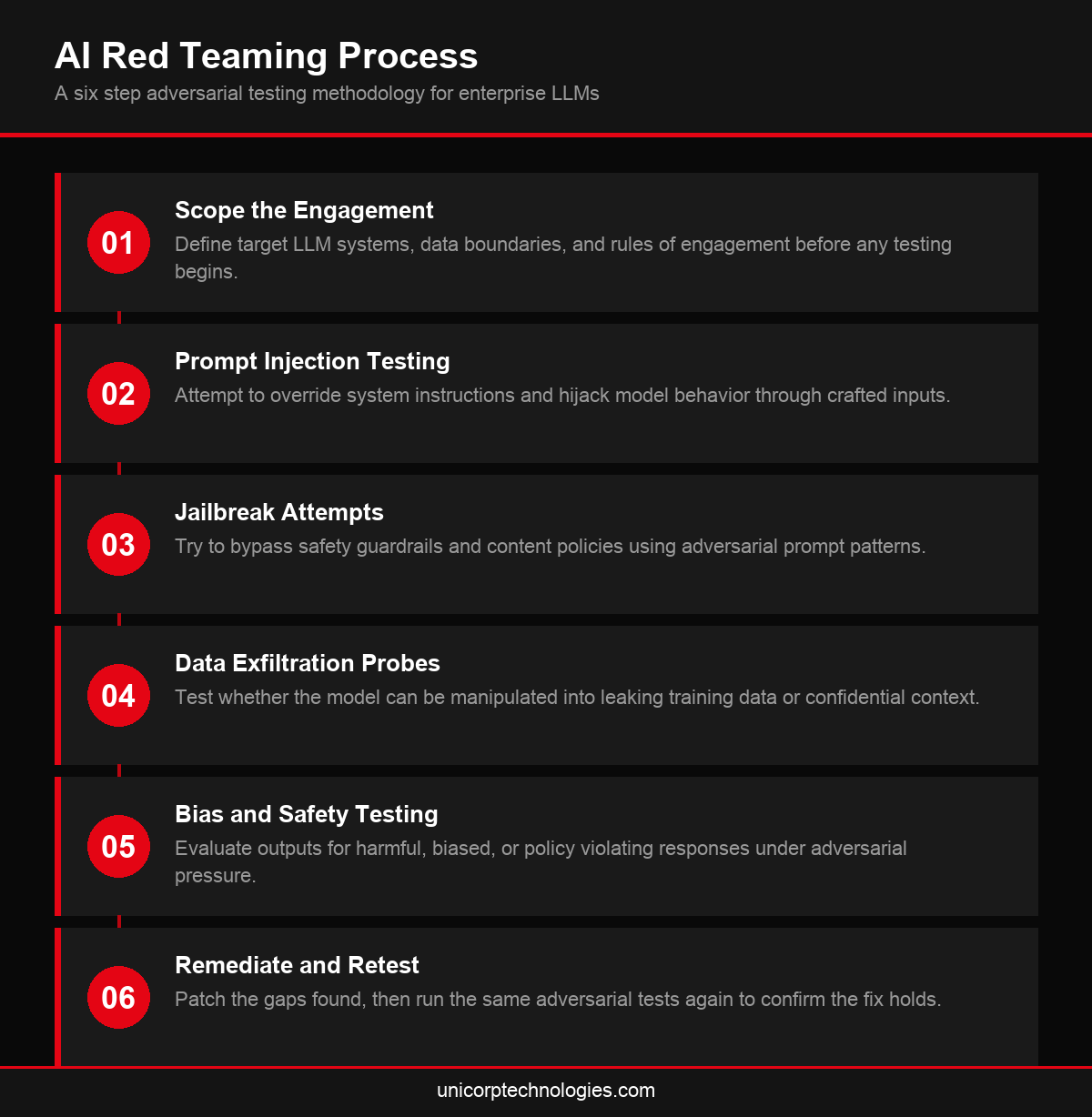 six stage AI red teaming process from scoping to retesting
What Adversarial Testing Actually Probes
Effective AI red teaming covers four core test categories: prompt injection, jailbreak attempts, data exfiltration probes, and bias or safety testing. Each targets a different way an LLM can be manipulated into unsafe, inaccurate, or unauthorized behavior, and each requires its own set of crafted adversarial inputs.
Prompt injection testing tries to override a model's system instructions using crafted inputs, a risk explored in more depth in our earlier analysis of prompt injection attacks. Jailbreak testing uses adversarial phrasing to bypass safety guardrails and content policies. Data exfiltration probes attempt to manipulate a model into revealing training data, system prompts, or confidential context it should not expose. Bias and safety testing evaluates whether outputs remain fair, accurate, and policy compliant under adversarial pressure, not only under normal use. Together these four categories map closely to risks catalogued in the OWASP Top 10 for LLM Applications, giving enterprises a recognized reference point when scoping a vendor engagement or an internal ai security guardrails program. Enterprises building this capability should also ask whether cybersecurity software used elsewhere in the security stack can ingest red teaming findings, since a vulnerability found in an LLM often needs the same tracking and remediation workflow as any other logged security issue.
Build Internally or Bring In a Vendor
UAE enterprises can build AI red teaming capability internally or engage a specialist vendor. The right choice depends on in house AI security expertise, deployment scale, and how frequently models change. Many organizations start with a vendor led assessment, then build ongoing internal testing once baseline guardrails are in place.
An internal program needs security engineers who understand both adversarial testing techniques and how large language models actually fail, a skill set still rare inside most enterprise security teams. A vendor engagement brings that expertise immediately, along with structured methodology and independent validation that internal teams sometimes lack. AI red teaming is best understood as the AI era evolution of vulnerability assessment services and penetration testing, applied to a new attack surface. Enterprises already running regular VAPT programs are well positioned to extend that same discipline to their AI deployments, treating LLM red teaming as a standing requirement rather than a one time project ahead of launch. Guidance such as the NIST AI Risk Management Framework reinforces why structured testing, not one off review, is now the expected baseline. Whichever path an enterprise chooses, the goal stays the same: measurable ai cybersecurity assurance backed by documented adversarial test results, not a vendor's word that a model is safe.
What Good Red Teaming Documentation Looks Like
A red teaming engagement is only as useful as its documentation. Enterprises should expect a written report mapping each finding to a specific test case, severity rating, and remediation status, not a generic summary describing risks identified.
Ask any vendor for a sample report structure before signing a statement of work. A strong report lists each adversarial test case attempted, whether it succeeded or failed, the specific guardrail or prompt weakness exploited, and a clear remediation owner. This level of detail supports audit requirements under frameworks like ISO 27001 and UAE NESA guidance, where evidence of proactive testing matters as much as the fix itself. Enterprises should also request a retest report confirming that closed findings do not reopen after a model update, a common gap when providers treat red teaming as a one off exercise rather than a continuous discipline tied to the deployment lifecycle. Enterprises should also confirm that reporting integrates cleanly with whatever cybersecurity software already tracks vulnerabilities across the rest of the organization, so AI findings do not sit in a separate, easily forgotten spreadsheet. Many organizations fold this reporting requirement directly into existing vulnerability assessment services contracts rather than negotiating a separate line item for AI specific testing.
AI cybersecurity now depends on testing model behavior as rigorously as network infrastructure. AI red teaming gives UAE enterprises a structured way to find prompt injection gaps, jailbreak weaknesses, and data exposure risks before attackers exploit them. The process outlined here, scope, test, remediate, retest, should apply whether the work happens in house or through a specialist partner. Enterprises deploying LLMs in regulated sectors cannot treat this as optional, and building ai cybersecurity maturity now costs far less than recovering from a preventable incident later.
AI cybersecurity leaders should treat red teaming as a launch requirement, not an afterthought. Contact Unicorp Technologies to scope an AI red teaming engagement for your enterprise LLM deployment.