Cloud Security Audit UAE 2027: Abu Dhabi Budget Guide

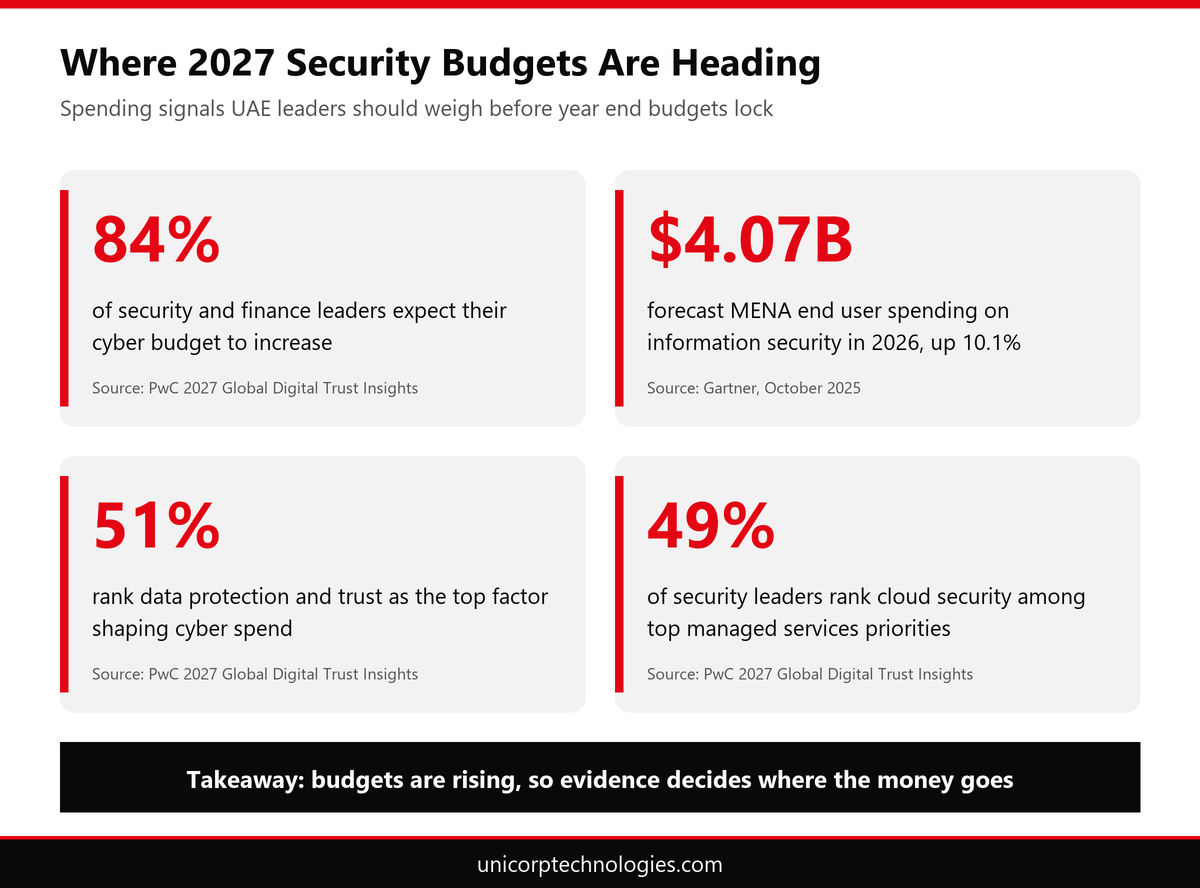
Security budgets are rising, and finance teams in Abu Dhabi are deciding where that money goes right now. A cloud security audit UAE 2027 plans can rely on shows which gaps deserve funding first. The PwC 2027 Global Digital Trust Insights survey of 3,934 business and technology leaders found that 84% of security and finance leaders expect their cyber budget to increase.
This guide sets out where organisations are putting their security spend, what UAE threat data says about priorities, and how to run a short audit before budgets lock. If you want a second opinion on your 2027 plan, you can speak with the Unicorp security team before year end.
Key Takeaways
- Most leaders plan to spend more on security next year, with AI, data protection and cloud security leading the list.
- Effective cybersecurity budget planning 2027 UAE business leaders can defend starts with evidence, and an audit in Q4 supplies that evidence.
- Firms without deep internal teams increasingly look for a managed security services provider near me Dubai or Abu Dhabi offices can reach quickly, so skills gaps do not stall new spending.
Where 2027 Security Budgets Are Heading
Budgets are growing again after several relatively flat years. Leaders are steering new money toward data protection, AI security and cloud controls instead of simply renewing last year's tools.
PwC describes cyber spending as back. Among security and finance leaders, 84% expect budgets to increase, six percentage points higher than the previous year. A further 58% of security leaders rank AI among their top cyber budget priorities.
When asked what drives spending choices, 51% ranked data protection and trust first. Securing against AI enabled attacks followed at 46%, and securing AI systems and autonomous agents came next at 45%. These are the categories competing for the same pool of money in most boardrooms this quarter.
The regional picture points the same way. Gartner forecast in October 2025 that MENA end user spending on information security would reach about $4.07 billion in 2026, up 10.1% on 2025. Security software accounts for 48% of that total, with endpoint protection and cloud security posture management named as the main growth drivers.
Security services are also expanding. Gartner puts MENA spending on security services at $1,522 million in 2026, growth of 10.6%. That reflects how many organisations now buy expertise alongside technology. For leaders working through cybersecurity budget planning 2027 UAE business cycles demand, the real challenge is spending well.
What the UAE Threat Picture Says About Priorities
National data shows that many successful attacks begin with basic weaknesses. That makes configuration, access and monitoring the first places a 2027 budget should look.
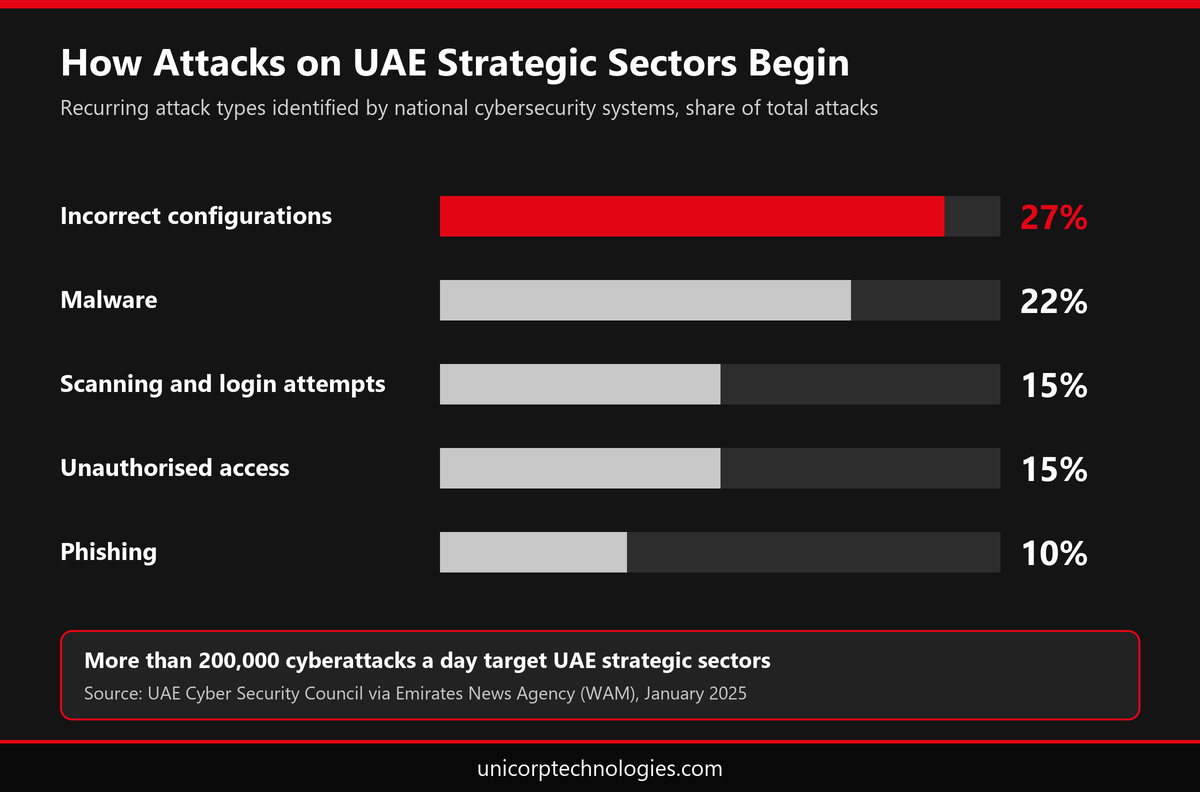
In January 2025 the UAE Cyber Security Council reported that cyberattacks targeting strategic sectors in the country had reached more than 200,000 a day. According to the Emirates News Agency report on the Council's findings, the government sector drew 30% of these attacks, with financial services and education at 7% each.
The most useful detail for budget holders is the breakdown of attack types. Incorrect configurations accounted for 27% of total attacks, the largest single category. Malware followed at 22%, scanning and login attempts at 15%, unauthorised access at 15% and phishing at 10%.
That ranking matters for spending. Misconfigured cloud storage, open admin portals and overly broad permissions do not need an expensive new platform to fix. They need someone to find them, rank them and close them. Our article on hidden risks that posture management exposes explains how these gaps build up as cloud estates grow.
The Council also warned that attackers are using AI to improve malware, including ransomware. The IBM Cost of a Data Breach Report 2026 puts the global average breach cost at $4.99 million, a 12% increase and a record high, and it reports a 56% increase in AI driven attacks.
Run a Cloud Security Audit UAE 2027 Budgets Can Use
A short, focused audit turns budget debates into decisions. It shows finance and IT leaders in Abu Dhabi which risks are real, which tools are underused and where new money will reduce exposure.
PwC found that 40% of security leaders see cloud related threats as one of their biggest preparedness gaps. Only 49% of organisations have fully implemented data classification policies, and 48% have data loss prevention across key egress channels. On average, companies have implemented only three of seven key data risk measures.
Timing matters as much as scope. An audit that finishes in January arrives after the numbers are fixed. Aim to complete fieldwork in November and present findings early in December, while finance teams can still move money between lines. Two to three weeks of focused review on your main cloud accounts and critical applications usually produces enough evidence to guide decisions.
A practical audit should cover five areas:
- Configuration review: check storage, networking and identity settings across every cloud account against your own baseline.
- Identity and access: list privileged accounts, unused access and service identities, then confirm multifactor authentication coverage.
- Data exposure: map where sensitive data sits, who can reach it and whether classification and loss prevention apply.
- Detection and response: confirm which logs reach your monitoring tools and who acts on alerts out of hours.
- Recovery: test whether backups restore within the time your business can tolerate.
External testing adds evidence the board can trust. Our comparison of VAPT and red teaming explains which approach suits a pre budget review. If you already buy cloud security services, read what to expect from a cloud security partner and check the current contract against what the audit finds. You can also see the security and compliance work Unicorp delivers, including identity and access management and security operations monitoring and auditing.
Turning Audit Findings Into a Defensible Budget
Audit results only help if they shape the final numbers. Group findings by risk, cost and ownership so each budget line links directly to a specific gap.
Start by sorting findings into three groups. Quick fixes are configuration and access changes your team can make this quarter at little cost. Funded projects are gaps that need new tools or significant effort, such as posture management or wider loss prevention. Capacity gaps are areas where you have the tools but lack the people to run them.
Give every finding an owner and a cost estimate. Finance leaders respond better to a short list of priced, ranked actions than to a long technical report. Where possible, show the risk each line reduces in plain business terms, such as downtime avoided or regulatory exposure removed.
Capacity is often the hardest line to justify. PwC found that security leaders rank AI (53%), cloud security (49%), data protection (42%) and threat management (39%) among their top priorities for managed security services. Organisations are buying specialist skills instead of trying to hire every role internally.
That is why many Abu Dhabi firms compare cyber security companies in UAE cities they can visit, and why teams further north shortlist a managed security services provider near me Dubai can support in person. Unicorp's professional services team covers solution design, implementation, support agreements on 8x5 or 24x7 terms, and IT resourcing on an operating budget. For cloud workloads, SkyAlchemX cloud operations add usage audits and cost management.
Continuity deserves its own line too. PwC found that only 39% of security, risk and operations leaders have fully formalised continuity plans that specifically address cyber threats. Resilient infrastructure and recovery capacity keeps a single incident from becoming a long outage.
Keep the paper short when it reaches the budget committee. One page listing each finding, its cost, its owner and the risk it removes will travel further than a long report, and it gives Abu Dhabi finance teams something they can compare directly with other requests for the same money. Treat all of these figures as an outlook. Threats will keep changing through 2027, so build a mid year review into the budget and reserve a small contingency for new risks.
Conclusion
UAE organisations are entering 2027 with larger security budgets and sharper threats. Money is flowing toward data protection, AI security and cloud controls, while national figures show misconfiguration as the most common way in. A cloud security audit UAE 2027 planning teams run before budgets close links every dirham to a real gap and shows where managed support adds more value than new tools. Unicorp has supported organisations from offices in Abu Dhabi and Dubai since 2008. Book a pre budget security review with our specialists and finalise your plan with confidence.
Frequently Asked Questions
What should a cloud security audit UAE 2027 budget review include?

When should Abu Dhabi businesses run a security audit before budgets close?
How many organisations expect cybersecurity budgets to rise for 2027?
How fast is security spending growing in the Middle East?
What is the most common type of attack in UAE national data?
Why should a cybersecurity budget start with an audit?
Should UAE firms use managed security services or hire in house?
How does security budgeting differ from general IT budgeting?
What does a data breach cost organisations today?
How can Unicorp help with 2027 security planning?