2027 Cyber Threat Landscape: Why Gulf SMEs Are Now Prime Targets, Not Just Enterprises
Gulf business owners once assumed attackers only chased banks, ministries and energy giants. The World Economic Forum Global Cybersecurity Outlook 2026 found that small organisations are twice as likely as large ones to report insufficient cyber resilience. That gap is exactly what criminal groups now target. For owners comparing cybersecurity services UAE firms can realistically adopt, the question is no longer whether they will be targeted, but how fast they can close the gap.
This guide explains why Gulf SMEs have become prime targets, what current UAE and global data shows, and which controls matter most as planning for 2027 begins. If you already suspect weak spots in your environment, you can talk to the Unicorp security team for a practical review.
Key Takeaways
- Ransomware appeared in 88% of breaches at small and medium businesses, compared with 39% at large organisations, so size no longer offers cover.
- UAE data shows more ransomware groups, more exposed assets and more leaked credentials, which makes cybersecurity services UAE SMEs can scale a board level priority.
- A managed cybersecurity provider for SMEs UAE businesses trust can close the skills gap faster than hiring a full internal team.
Why Attackers Have Moved Down Market
Criminal groups now treat SMEs as efficient targets. Smaller firms hold valuable data and payment access, yet usually run thinner defences, fewer specialists and weaker backups than large enterprises.
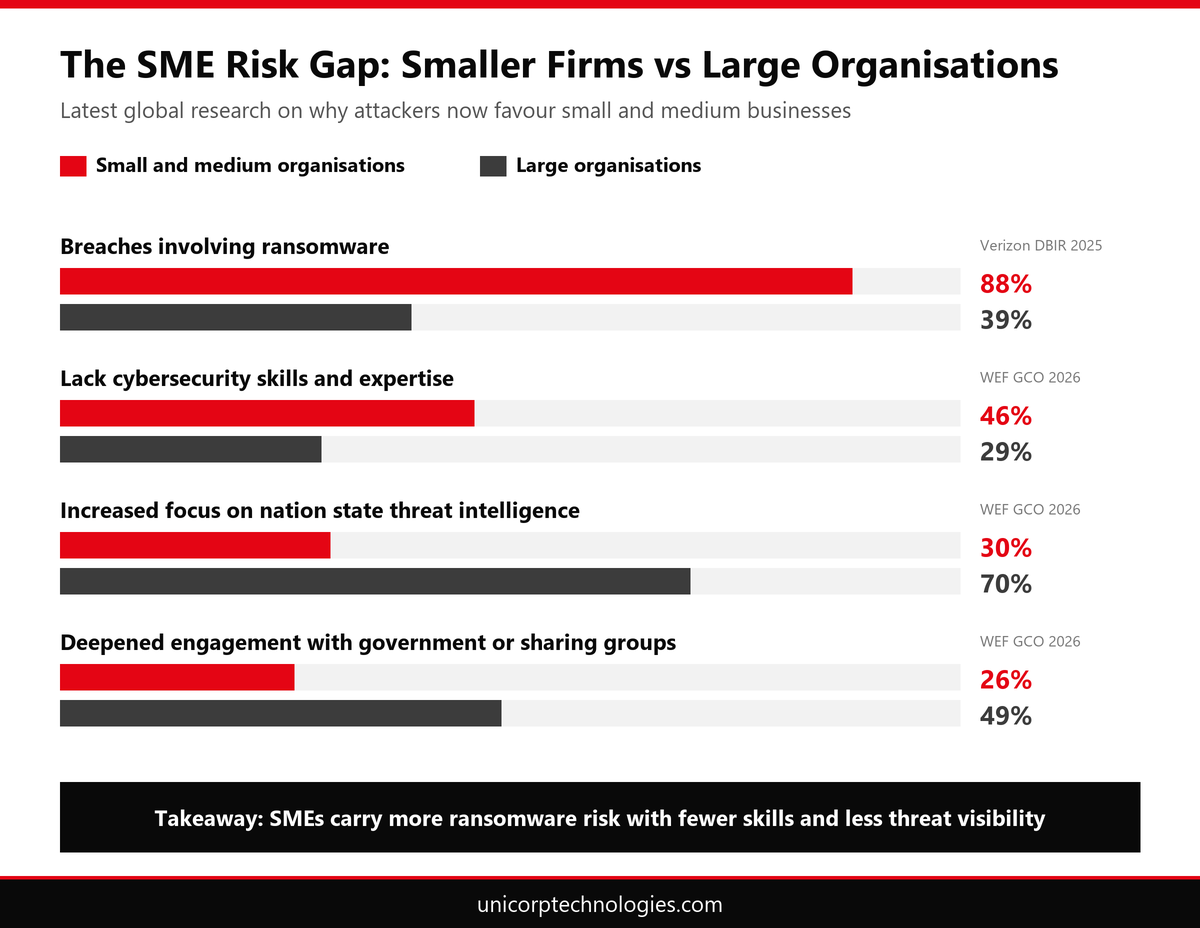
The Verizon 2025 Data Breach Investigations Report SMB Snapshot reviewed 12,195 confirmed breaches, a record high. Its most striking finding is the ransomware gap. Ransomware featured in 88% of SMB breaches but only 39% of breaches at larger organisations. The report says ransomware groups do not seem to care about company size. They simply adjust their demands.
The economics explain the shift. Large enterprises have hardened their perimeters, so attackers look for easier returns. A trading company, clinic or logistics firm in Dubai may pay a smaller ransom, but it often pays faster. Verizon also notes that SMBs are less likely to hold current, readily available backups. That single weakness turns an intrusion into a business stopping event.
Smaller firms also sit inside larger supply chains. Verizon found that breaches involving a third party doubled from 15% to 30%. Attackers use a small supplier as a quiet route into a bigger client. For an SME, that means a breach can cost both revenue and key contracts.
Smaller firms also see less of what is coming. The WEF outlook reports that 70% of organisations with more than 100,000 employees have increased their focus on nation state threat intelligence, against only 30% of employers with 1,000 staff or fewer. Just 26% of those smaller employers have deepened engagement with government agencies or information sharing groups, compared with 49% of the largest. Less intelligence means less warning before an attack lands.
What the UAE Data Shows About the Local Threat Picture
Local evidence confirms the global trend. UAE data points to more active ransomware groups, a large internet facing footprint and widespread credential theft affecting organisations of every size.
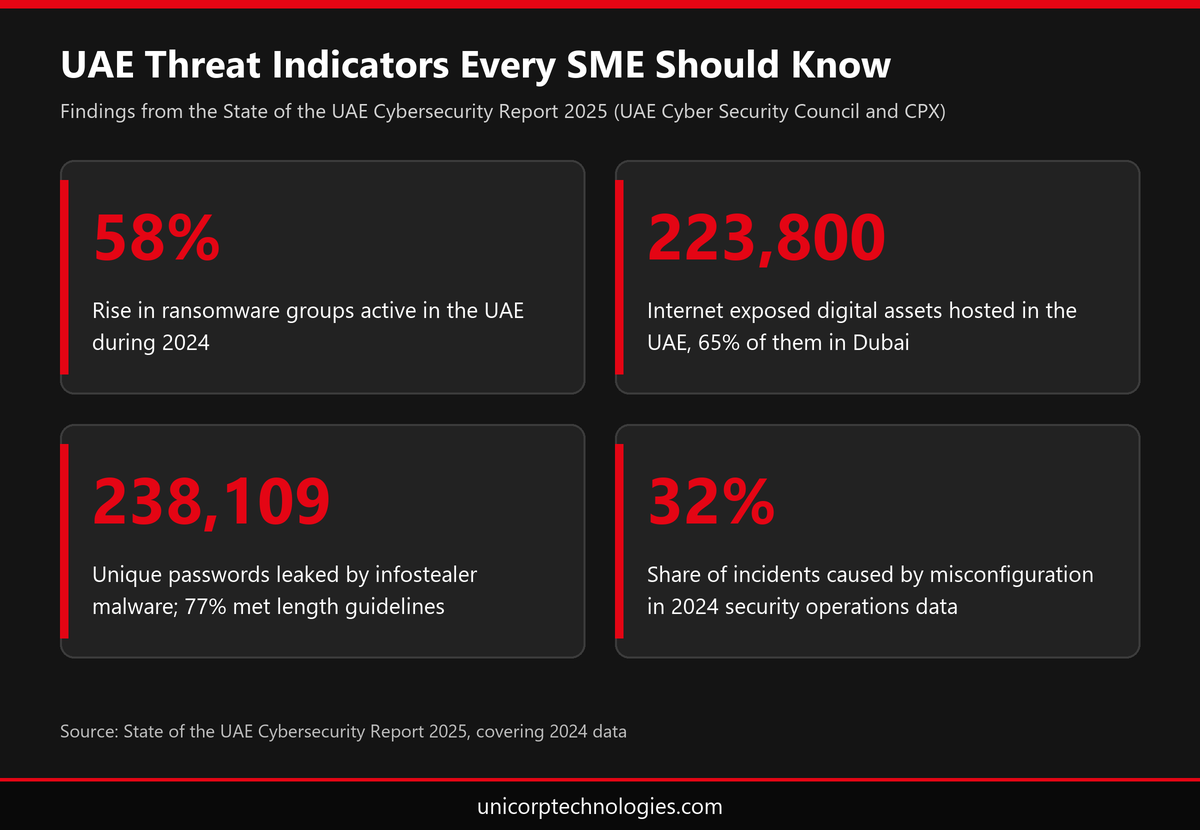
The State of the UAE Cybersecurity Report 2025, developed by the UAE Cyber Security Council with CPX, found that the number of ransomware groups active in the UAE rose by 58% in 2024. New groups emerged throughout the year, supported by affiliates who rent out ransomware tools as a service.
The same report counted about 223,800 internet exposed digital assets hosted in the UAE, with Dubai accounting for 65% of them. Many of those assets belong to growing businesses that moved services online quickly. Every exposed server, VPN gateway or admin portal is a potential entry point.
Credential theft adds a further layer of risk. The report analysed 238,109 unique passwords leaked by infostealer malware and found that 77.04% met recommended length guidelines. Long passwords still failed because the devices holding them were infected. For an SME, this is a warning that password rules alone cannot protect business email, cloud apps or banking portals.
Configuration mistakes are another common trigger. In CPX security operations data for 2024, misconfiguration accounted for 32% of incidents, the largest single category. For growing firms that add cloud services, firewalls and remote access tools quickly, a single wrong setting can expose files or admin panels to the whole internet. Choosing cybersecurity services UAE teams can audit regularly helps catch these errors before attackers do.
The Weak Points Attackers Exploit in Gulf SMEs
Most SME breaches start with a small number of predictable gaps. Stolen logins, unpatched edge devices, unmanaged personal laptops and convincing social engineering account for most incidents.
Stolen credentials remain the leading way in. Verizon found that the use of stolen credentials appeared in 33% of SMB breach actions. Exploitation of vulnerabilities reached 20% of initial access vectors. Edge devices and VPNs made up 22% of those exploitation targets, up from 3% a year earlier.
Patching is the practical problem. Only about 54% of edge device vulnerabilities were fully remediated during the year, and fixes took a median of 32 days. A small IT team juggling daily support rarely has time to track every firmware release. Our guide to the most common vulnerabilities found in UAE organisations shows how these gaps persist.
Personal devices add hidden exposure. In the infostealer data Verizon analysed, 46% of compromised systems holding corporate logins were unmanaged devices. That pattern fits the hybrid working common across the Gulf.
Social engineering completes the picture. Verizon reports that pretexting attacks are more common in SMBs than in large organisations. Voice cloning makes this worse, as our article on deepfake voice scams in the UAE explains.
Building an SME Defence Plan for 2027
SMEs do not need enterprise budgets to defend well. They need the right priorities, clear ownership and partners who can supply the skills and monitoring that small teams lack.
Skills are the real constraint. The WEF outlook found that 46% of small organisations lack cybersecurity skills and expertise, compared with 29% of large organisations. Hiring a full internal security team is rarely realistic for a business with fifty or two hundred staff. That is why cybersecurity services UAE SMEs buy increasingly come as managed or shared arrangements.
Start with identity. Enforce multifactor authentication on email, VPN and cloud apps, and review who holds admin rights. Identity and access management and endpoint protection close the routes attackers use most.
Next, fix exposure and recovery. Keep an inventory of internet facing systems, patch edge devices on a defined schedule, and test backups regularly. Resilient data protection and disaster recovery infrastructure is what turns a ransomware attack into an inconvenience rather than a crisis.
Finally, arrange monitoring you can sustain. A managed cybersecurity provider for SMEs UAE firms rely on can watch alerts around the clock, escalate real incidents and advise on containment. Unicorp's professional services team offers support agreements on 8x5 or 24x7 terms, plus IT resourcing on an operating budget. Businesses planning cloud moves can also work with a cloud security consulting company Dubai 2027 plans can build on, so security is designed in from the start.
When comparing providers, ask practical questions. Which log sources will they monitor, and who approves containment actions out of hours? How are alerts escalated, and what reports will your management team receive each month? Clear answers matter more than long feature lists.
Looking ahead, expect these pressures to grow rather than fade. The WEF outlook found that 73% of respondents, or someone in their network, were affected by cyber enabled fraud during 2025. As AI tools make phishing and impersonation cheaper, SMEs should plan their 2027 security budgets on the assumption that attempts will become more frequent and more convincing.
Conclusion
The 2027 outlook for Gulf SMEs is clear. Attackers follow weak defences, not company size, and the latest UAE and global data shows smaller firms carrying most of the ransomware risk. The good news is that the fixes are well understood: strong identity controls, disciplined patching, tested backups and continuous monitoring. The right cybersecurity services UAE SMEs choose today will decide how they handle the threats of the coming year. Unicorp has supported organisations from offices in Abu Dhabi and Dubai since 2008. Book a security consultation with our specialists to map your risks and build a plan that fits your budget.
Frequently Asked Questions
Why are Gulf SMEs now prime targets for cyberattacks?

What are the first cybersecurity services UAE SMEs should invest in?
How does a managed cybersecurity provider for SMEs in the UAE help?
Is ransomware really a risk for small businesses in Dubai and Abu Dhabi?
Why do long passwords still get stolen?
How much should an SME budget for cybersecurity in 2027?
What role does a cloud security consultant play for SMEs?
Can SMEs rely on antivirus software alone?
How quickly should SMEs patch firewalls and VPN devices?
How can Unicorp support SMEs with cybersecurity?